Thursday, May 23, 2019

Buffalo Hunt attributed to Karl Ferdinand Wimar (1828-1862)

Attr to Karl Ferdinand Wimar (1828-1862 a painter of the American West was also known as Charles Wimar & Carl Wimar)  Buffalo Hunt

According to historian Pekka Hämäläinen, a few Native American tribes plus weather conditions partly contributed to the collapse of the bison population in America's southern Plains. By the 1830s, the Comanche & their allies on the southern plains were killing about 280,000 bison a year, which was near the limit of sustainability for that region. Firearms & horses, along with a growing export market for buffalo robes & bison meat had resulted in larger & larger numbers of bison killed each year. A long & intense drought hit the southern plains in 1845, lasting into the 1860s, which caused a widespread collapse of the bison herds. In the 1860s, the rains returned & the bison herds recovered to a degree.

The Comanche are a Native American tribe from the Great Plains, Rockies, Texas, & the Ozarks in the United States. Along with the Sioux, the Comanche often raided the American West from the 1850s until the 1868-1875 Red River War, which destroyed the Plains Indians & forced the Comanche to submit to the Americans. The Comanche emerged as a distinct group shortly before 1700, when they broke off from the Shoshone people living along the upper Platte River in Wyoming. In 1680, the Comanche acquired horses from the Pueblo Indians after the Pueblo Revolt. They separated from the Shoshone after this, as the horses allowed them greater mobility in their search for better hunting grounds.

The horse was a key element in the emergence of a distinctive Comanche culture. It was of such strategic importance that some scholars suggested that the Comanche broke away from the Shoshone & moved southward to search for additional sources of horses among the settlers of New Spain to the south (rather than search for new herds of buffalo.) The Comanche may have been the 1st group of Plains natives to fully incorporate the horse into their culture & to have introduced the animal to the other Plains peoples. From Natchitoches in Spanish Louisiana, Athanase de Mézières reported in 1770 that the Comanches were

Their original migration took them to the southern Great Plains, into a sweep of territory extending from the Arkansas River to central Texas. They reached present-day New Mexico & the Texas Panhandle by 1700, forcing the Lipan Apache people ever southward, defeating them in a nine-day battle along the Rio del Fierro (Wichita River) in 1723. The river may be the location mentioned by Athanase de Mézières in 1772, containing "a mass of metal which the Indians say is hard, thick, heavy, & composed of iron," which they "venerate...as an extraordinary manifestation of nature," the Comanche's calling it Ta-pic-ta-carre [standing rock], Po-i-wisht-carre [standing metal], or Po-a-cat-le-pi-le-carre [medicine rock], the general area containing a "large number of meteoric masses." By 1777, the Lipan Apache had retreated to the Rio Grande & the Mescalero Apache to Coahuila.

During that time, their population increased dramatically because of the abundance of buffalo, an influx of Shoshone migrants, & their adoption of significant numbers of women & children taken captive from rival groups. The Comanche never formed a single cohesive tribal unit, but were divided into almost a dozen autonomous groups, called bands. These groups shared the same language & culture, & rarely fought each other. They were estimated to have taken captive thousands of people from the Spanish, Mexican & American settlers in their lands.

By the mid-19C, the Comanche were supplying horses to French & American traders & settlers, & later to migrants passing through their territory on the way to the California Gold Rush, along the California Road. The Comanche had stolen many of the horses from other tribes & settlers; they earned their reputation as formidable horse thieves, later extending their rustling to cattle. Their stealing of livestock from Spanish & American settlers, as well as the other Plains tribes, often led to battles.

The Comanche also had access to vast numbers of feral horses, which numbered approximately 2,000,000 in & around Comancheria, & which the tribe was particularly skilled at breaking to saddle. In the late 18C & early 19C, the Comanche lifestyle required about one horse per person (though warriors each possessed many more). With a population of about 30,000 to 40,000 & in possession of herds many times that number, the Comanche had a surplus of about 90,000 to 120,000 horses.

They were formidable opponents who developed strategies for using traditional weapons for fighting on horseback. Warfare was a major part of Comanche life. Comanche raids into Mexico traditionally took place during the full moon, when the Comanche could see to ride at night. This led to the term "Comanche Moon," during which the Comanche raided for horses, captives, & weapons. The majority of Comanche raids into Mexico were in the state of Chihuahua & neighboring northern states.

Wednesday, May 22, 2019

Woman Returning to the Tribe in the Snow with Sticks to Burn with by Cassilly Adams (1843-1921)

Cassilly Adams (American artist, 1843-1921) Returning to the Tribe

A descendant of President John Adams, Kassilli or Cassilly Adams (1843-1921) was born  in Zanesville, Ohio. His father, William Adams, was an amateur painter. Young Cassilly studied painting at the Academy of Art in Boston and Cincinnati Art School. During the Civil War he served in the US Navy.

From Europe to the Atlantic coast of America & on to the Pacific coast during the 17C-19C, settlers moved West encountering a variety of Indigenous Peoples who had lived on the land for centuries. By 1880, Adams was living in St. Louis. In 1884, the artist created a monumental canvas depicting the Battle of the Little Bighorn (death of the Seventh Cavalry Regiment of the US Army and its famous commander George Custer) - "Custer's Last Fight." The painting was exhibited across the country, and then was purchased by the company "Anheuser-Busch" and later donated to the Seventh Cavalry. After the restoration of the original during the Great Depression, it was exhibited in the officers' club at Fort Bliss (Texas), and June 13, 1946 was burned in a fire. Despite the success of "Custer's Last Fight," Adams remained a relatively unknown artist. He focused on the image of Indians American West Plains life, worked as an illustrator, a farmer. He died Kassilli Adams May 8, 1921 in Traders Point near Indianapolis.

Monday, May 20, 2019

American artist Seth Eastman (1808-1875) portrays an Indian Council Meeting

Seth Eastman (American artist, 1808-1875) Indian Council

Born in 1808 in Brunswick, Maine, Seth Eastman (1808-1875) found expression for his artistic skills in a military career. After graduating from the US Military Academy at West Point, where officers-in-training were taught basic drawing & drafting techniques, Eastman was posted to forts in Wisconsin & Minnesota before returning to West Point as assistant teacher of drawing. --- While at Fort Snelling, Eastman married Wakaninajinwin (Stands Sacred), the 15-year-old daughter of Cloud Man, Dakota chief. Eastman left in 1832, for another military assignment soon after the birth of their baby girl, Winona, & he declared his marriage ended when he left. Winona was also known as Mary Nancy Eastman & was the mother of Charles Alexander Eastman, author of Indian Boyhood. --- From 1833 to 1840, Eastman taught drawing at West Point. In 1835, he married his 2nd wife & was reassigned to Fort Snelling as a military commander & remained there with Mary & their 5 children for the next 7 years. During this time Eastman began recording the everyday way of life of the Dakota & the Ojibwa people. Transferred to posts in Florida, & Texas in the 1840s, Eastman made sketches of the native peoples there. This experience prepared him for the next 5 yeas in Washington, DC, where he was assigned to the commissioner of Indian Affairs & illustrated Henry Rowe Schoolcraft's important 6-volume Historical  Statistical Information Respecting the History, Condition, & Prospects of the Indian Tribes of the United States. In 1867, Eastman returned to the Capitol to paint a series of scenes of Native American life for the House Committee on Indian Affairs. From the office of the United States Senate curator, we learn that in 1870, the House Committee on Military Affairs commissioned artist Seth Eastman 17 to paint images of important fortifications in the United States. He completed the works between 1870 & 1875. Of his 17 paintings of forts, 8 are located in the Senate, while the others are displayed on the House side of the Capitol. Eastman was working on the painting West Point, when he died in 1875.

Saturday, May 18, 2019

Karl Ferdinand Wimar (1828-1862) The Captive Charger

Karl Ferdinand Wimar (1828-1862) a painter of the American West (was also known as Charles Wimar & Carl Wimar) The Captive Charger

A German-born immigrant to the United States, Charles Wimar(1828-1862) was fascinated by the American frontier.   In 1843, he traveled to St. Louis, a fur-trading frontier town at the time. Between 1846 & 1850, he was apprenticed to the artist Leon de Pomarede, & accompanied him on a journey up the Mississippi, to St. Anthony Falls in Minnesota. In 1852, Wimar returned to Germany; & for 4 years, he studied with with Emmanuel Leutze & Josef Fay in Düsseldorf. After his return to the United States, Wimar took several journeys up the Mississippi River and, in 1858, up the Yellowstone River – documented in various sketchbooks. When he died from tuberculosis at the age of 34, he left about 50 paintings. Wimar's paintings, like others of the time, reinforced notions of Native Americans as savage & white settlers as cultivated & divinely ordained - a notion that helped justify white colonization of the West. 

Thursday, May 16, 2019

George Martin Ottinger (American artist, 1833-1917) Encampment at The Great Salt Lake From The Foot of Ensign Peak

George Martin Ottinger (American, 1833-1917) The Great Salt Lake From The Foot of Ensign Peak

Between 1860 and 1863, three painters, George Martin Ottinger (1833-1917), Daniel Weggeland (1829-1918), and John Tullidge (1826-99), were brought to Utah and employed at painting scenery for the Salt Lake Theater, and later, murals for the ceremonial chambers of Mormon temples. These 3 men, though they came from New England, Norway, and England, respectively, had all matured in the same general tradition. Ottinger received his instruction under teachers imbued with the precepts of the Hudson River School of Landscape. His work is literal and often quite static, but his enthusiasm for legendary subjects keeps interest in his work fresh and usually stirs the curiosity of those who have not known his paintings before. Weggeland, Tullidge, and Ottinger banded together in 1863, and organized the Deseret Academy of Fine Arts, the first such school in the West; they were forced by a lack of paying students to close their doors within a few months. Weggeland, reporting the enterprise in a letter home, said that he could occasionally dispose of a painting or a lesson for a few home-knit socks or a basket of onions, but that without his commissions for the Salt Lake Theater he would never have been able to pay his rent.

Tuesday, May 14, 2019

American artist Seth Eastman (1808-1875) portrays Native Americans

Seth Eastman (American artist, 1808-1875) Death Whoop

From Europe to the Atlantic coast of America & on to the Pacific coast during the 17C-19C, settlers moved West encountering a variety of Indigenous Peoples who had lived on the land for centuries.

Born in 1808 in Brunswick, Maine, Seth Eastman (1808-1875) found expression for his artistic skills in a military career. After graduating from the US Military Academy at West Point, where officers-in-training were taught basic drawing & drafting techniques, Eastman was posted to forts in Wisconsin & Minnesota before returning to West Point as assistant teacher of drawing. --- While at Fort Snelling, Eastman married Wakaninajinwin (Stands Sacred), the 15-year-old daughter of Cloud Man, Dakota chief. Eastman left in 1832, for another military assignment soon after the birth of their baby girl, Winona, & he declared his marriage ended when he left. Winona was also known as Mary Nancy Eastman & was the mother of Charles Alexander Eastman, author of Indian Boyhood. --- From 1833 to 1840, Eastman taught drawing at West Point. In 1835, he married his 2nd wife & was reassigned to Fort Snelling as a military commander & remained there with Mary & their 5 children for the next 7 years. During this time Eastman began recording the everyday way of life of the Dakota & the Ojibwa people. Transferred to posts in Florida, & Texas in the 1840s, Eastman made sketches of the native peoples there. This experience prepared him for the next 5 yeas in Washington, DC, where he was assigned to the commissioner of Indian Affairs & illustrated Henry Rowe Schoolcraft's important 6-volume Historical  Statistical Information Respecting the History, Condition, & Prospects of the Indian Tribes of the United States. In 1867, Eastman returned to the Capitol to paint a series of scenes of Native American life for the House Committee on Indian Affairs. From the office of the United States Senate curator, we learn that in 1870, the House Committee on Military Affairs commissioned artist Seth Eastman 17 to paint images of important fortifications in the United States. He completed the works between 1870 & 1875. Of his 17 paintings of forts, 8 are located in the Senate, while the others are displayed on the House side of the Capitol. Eastman was working on the painting West Point, when he died in 1875.

Sunday, May 12, 2019

Native Americans by Cassilly Adams (1843-1921)

 Cassilly Adams (American artist, 1843-1921) Returning from the Hunt

A descendant of President John Adams, Kassilli or Cassilly Adams (1843-1921) was born  in Zanesville, Ohio. His father, William Adams, was an amateur painter. Young Cassilly studied painting at the Academy of Art in Boston and Cincinnati Art School. During the Civil War he served in the US Navy.

From Europe to the Atlantic coast of America & on to the Pacific coast during the 17C-19C, settlers moved West encountering a variety of Indigenous Peoples who had lived on the land for centuries.

By 1880, Adams was living in St. Louis. In 1884, the artist created a monumental canvas depicting the Battle of the Little Bighorn (death of the Seventh Cavalry Regiment of the US Army and its famous commander George Custer) - "Custer's Last Fight." The painting was exhibited across the country, and then was purchased by the company "Anheuser-Busch" and later donated to the Seventh Cavalry. After the restoration of the original during the Great Depression, it was exhibited in the officers' club at Fort Bliss (Texas), and June 13, 1946 was burned in a fire. Despite the success of "Custer's Last Fight," Adams remained a relatively unknown artist. He focused on the image of Indians American West Plains life, worked as an illustrator, a farmer. He died Kassilli Adams May 8, 1921 in Traders Point near Indianapolis.

Friday, May 10, 2019

American artist Seth Eastman (1808-1875) portrays Native Americans

Seth Eastman (American artist, 1808-1875) Sioux Indians Breaking Up Camp

From Europe to the Atlantic coast of America & on to the Pacific coast during the 17C-19C, settlers moved West encountering a variety of Indigenous Peoples who had lived on the land for centuries.

Born in 1808 in Brunswick, Maine, Seth Eastman (1808-1875) found expression for his artistic skills in a military career. After graduating from the US Military Academy at West Point, where officers-in-training were taught basic drawing & drafting techniques, Eastman was posted to forts in Wisconsin & Minnesota before returning to West Point as assistant teacher of drawing. --- While at Fort Snelling, Eastman married Wakaninajinwin (Stands Sacred), the 15-year-old daughter of Cloud Man, Dakota chief. Eastman left in 1832, for another military assignment soon after the birth of their baby girl, Winona, & he declared his marriage ended when he left. Winona was also known as Mary Nancy Eastman & was the mother of Charles Alexander Eastman, author of Indian Boyhood. --- From 1833 to 1840, Eastman taught drawing at West Point. In 1835, he married his 2nd wife & was reassigned to Fort Snelling as a military commander & remained there with Mary & their 5 children for the next 7 years. During this time Eastman began recording the everyday way of life of the Dakota & the Ojibwa people. Transferred to posts in Florida, & Texas in the 1840s, Eastman made sketches of the native peoples there. This experience prepared him for the next 5 yeas in Washington, DC, where he was assigned to the commissioner of Indian Affairs & illustrated Henry Rowe Schoolcraft's important 6-volume Historical  Statistical Information Respecting the History, Condition, & Prospects of the Indian Tribes of the United States. In 1867, Eastman returned to the Capitol to paint a series of scenes of Native American life for the House Committee on Indian Affairs. From the office of the United States Senate curator, we learn that in 1870, the House Committee on Military Affairs commissioned artist Seth Eastman 17 to paint images of important fortifications in the United States. He completed the works between 1870 & 1875. Of his 17 paintings of forts, 8 are located in the Senate, while the others are displayed on the House side of the Capitol. Eastman was working on the painting West Point, when he died in 1875.

Wednesday, May 8, 2019

Seth Eastman (1808-1875) Native Americans Spearing Fish in Winter

Seth Eastman (American artist, 1808-1875) Spearing Fish in Winter

From Europe to the Atlantic coast of America & on to the Pacific coast during the 17C-19C, settlers moved West encountering a variety of Indigenous Peoples who had lived on the land for centuries.

From the office of the United States Senate curator, we learn that in 1870, the House Committee on Military Affairs commissioned artist Seth Eastman 17 to paint images of important fortifications in the United States. He completed the works between 1870 & amp; 1875. Born in 1808 in Brunswick, Maine, Seth Eastman (1808-1875) found expression for his artistic skills in a military career. After graduating from the US Military Academy at West Point, where officers-in-training were taught basic drawing & drafting techniques, Eastman was posted to forts in Wisconsin & Minnesota before returning to West Point as assistant teacher of drawing. --- While at Fort Snelling, Eastman married Wakaninajinwin (Stands Sacred), the 15-year-old daughter of Cloud Man, Dakota chief. Eastman left in 1832, for another military assignment soon after the birth of their baby girl, Winona, & he declared his marriage ended when he left. Winona was also known as Mary Nancy Eastman & was the mother of Charles Alexander Eastman, author of Indian Boyhood. --- From 1833 to 1840, Eastman taught drawing at West Point. In 1835, he married his 2nd wife & was reassigned to Fort Snelling as a military commander & remained there with Mary & their 5 children for the next 7 years. During this time Eastman began recording the everyday way of life of the Dakota & the Ojibwa people. Transferred to posts in Florida, & Texas in the 1840s, Eastman made sketches of the native peoples there. This experience prepared him for the next 5 yeas in Washington, DC, where he was assigned to the commissioner of Indian Affairs & illustrated Henry Rowe Schoolcraft's important 6-volume Historical  Statistical Information Respecting the History, Condition, & Prospects of the Indian Tribes of the United States. In 1867, Eastman returned to the Capitol to paint a series of scenes of Native American life for the House Committee on Indian Affairs. From the office of the United States Senate curator, we learn that in 1870, the House Committee on Military Affairs commissioned artist Seth Eastman 17 to paint images of important fortifications in the United States. He completed the works between 1870 & 1875. Of his 17 paintings of forts, 8 are located in the Senate, while the others are displayed on the House side of the Capitol. Eastman was working on the painting West Point, when he died in 1875.

Saturday, May 4, 2019

Indian in a Canoe by Albert Bierstadt (German-born American painter, 1830-1902)

Albert Bierstadt (German-born American painter, 1830-1902) The Indian canoe (approx. 1886)

Matthew Biagell explains in his book Albert Bierstadt that,"Athough Bierstadt made probing studies of individual Indians during his travels in the West, he usually generalized their appearances & activities in his paintings. He placed them, as he placed European peasants in earlier works, in the middle distance, so that we witness their presence in a landscape setting rather than focus on their movements." Many of his landscapes including Native Americans are the western equivalent of his European generalized landscapes & reveals Bierstadt's consistent attitude toward subject matter regardless of its locale human subjects are engaged in seemingly unrelated activities. His paintings, bathed in a golden glow, often suggest nostalgia for a previous age when Native Americans were thought to have lived harmoniously with nature. Here they are not wily, wicked, or predatory, but are engaged instead in peaceful domestic industry. Works such as this are obviously part of the broad western European tradition of Arcadian scenes, but in its American version the tradition assumes a particular complexity & ambivalence. His painting including Natives often portray the nobility of the Indians before their contact with Europeans & subsequent debasement. Paintings displaying this attitude undoubtedly provided the public with the images it wanted to see, especially during the years Indians were systematically being driven from their lands. Suchromanticized paintings might also be considered retardataire; the Indian, noble or otherwise, no longer engaged many serious 19C writers after the 1850s, & precise anthropological & linguistic analyses of Indian tribes were already being included in the Pacific railroad reports by that time.


Albert Bierstadt (German-born American painter, 1830-1902) was best known for these lavish, sweeping landscapes of the American West. To paint the scenes, Bierstadt joined several journeys of the Westward Expansion. Bierstadt, was born in Solingen, Germany. He was still a toddler, when his family moved from Germany to New Bedford in Massachusetts. In 1853, he returned to Germany to study in Dusseldorf, where he refined his technical abilities by painting Alpine landscapes. After he returned to America in 1857, he joined an overland survey expedition traveling westward across the country. Along the route, he took countless photographs & made sketches & returned East to paint from them. He exhibited at the Boston Athenaeum from 1859-1864, at the Brooklyn Art Association from 1861-1879, & at the Boston Art Club from 1873-1880. A member of the National Academy of Design from 1860-1902, he kept a studio in the 10th Street Studio Building, New York City from 1861-1879. He was a member of the Century Association from 1862-1902, when he died.

Thursday, May 2, 2019

19C Native American Women by Alfred Jacob Miller 1810-1874

Alfred Jacob Miller (American artist, 1810-1874) Indian Girl (Sioux)

"The amusements of these young girls is very limited - riding horses, when they can get them, swimming in the streams, which they can do like ducks, and playing with the dog. Fashion does not trouble their simple little heads, as is the case with their civilized sisters. Their dresses are not for the season but for all time, and as Nature has blessed them with a luxuriant supply of black hair, what do they want with a bonnet?" A.J. Miller, extracted from "The West of Alfred Jacob Miller" (1837). 

In July of 1858, Baltimore art collector William T. Walters commissioned 200 watercolors at $12  apiece from Baltimore-born artist Alfred Jacob Miller. These paintings were each accompanied by a descriptive text written by the artist, & were delivered in installments over the next 21 months & ultimately bound in 3 albums. These albums included the field-sketches drawn during Miller's 1837 expedition to the annual fur-trader's rendezvous in the Green River Valley (now western Wyoming).  These watercolors offer a unique record of the the lives of those involved in the closing years of the western fur trade & a look at the artist's opinions of both women & Native Americans. 

  The Walters Art Museum, Baltimore, Maryland.

Tuesday, April 30, 2019

A Native American running through the countryside by Cassilly Adams (1843-1921)

Cassilly Adams (American artist, 1843-1921) On the Run

A descendant of President John Adams, Kassilli or Cassilly Adams (1843-1921) was born  in Zanesville, Ohio. His father, William Adams, was an amateur painter. Young Cassilly studied painting at the Academy of Art in Boston and Cincinnati Art School. During the Civil War he served in the US Navy. From Europe to the Atlantic coast of America & on to the Pacific coast during the 17C-19C, settlers moved West encountering a variety of Indigenous Peoples who had lived on the land for centuries. By 1880, Adams was living in St. Louis. In 1884, the artist created a monumental canvas depicting the Battle of the Little Bighorn (death of the Seventh Cavalry Regiment of the US Army and its famous commander George Custer) - "Custer's Last Fight." The painting was exhibited across the country, and then was purchased by the company "Anheuser-Busch" and later donated to the Seventh Cavalry. After the restoration of the original during the Great Depression, it was exhibited in the officers' club at Fort Bliss (Texas), and June 13, 1946 was burned in a fire. Despite the success of "Custer's Last Fight," Adams remained a relatively unknown artist. He focused on the image of Indians American West Plains life, worked as an illustrator, a farmer. He died Kassilli Adams May 8, 1921 in Traders Point near Indianapolis.

Sunday, April 28, 2019

American artist Seth Eastman (1808-1875) portrays Native Americans

Seth Eastman (American artist, 1808-1875) Striking the Post Preparing for Counting Coup

Counting Coup played an extremely important part in the life of a Great Plains warrior. The above picture depicts American Indians striking the coup post during practise sessions. Counting coup refers to the winning of prestige against an enemy by the Plains Indians of North America. Warriors won prestige by acts of bravery in the face of the enemy, which could be recorded in various ways & retold as stories. Any blow struck against the enemy counted as a coup, but the most prestigious acts included touching an enemy warrior with the hand, bow, or coup stick & escaping unharmed. Touching the first enemy to die in battle or touching the enemy's defensive works also counted as coup. Counting coup could also involve stealing an enemy's weapons or horses tied up to his lodge in camp. Risk of injury or death was required to count coup. Escaping unharmed while counting coup was considered a higher honor than being wounded in the attempt. A warrior who won coup was permitted to wear an eagle feather in his hair. If he had been wounded in the attempt, however, he was required to paint the feather red to indicate this. After a battle or exploit, the people of a tribe would gather together to recount their acts of bravery & "count coup." Coups were recorded by putting notches in a coup stick. Indians of the Pacific Northwest would tie an eagle feather to their coup stick for each coup counted, but many tribes did not do so. Among the Blackfoot tribe of the upper Missouri River Valley, coup could be recorded by the placement of "coup bars" on the sleeves & shoulders of special shirts that bore paintings of the warrior's exploits in battle. Many shirts of this sort have survived to the present, including some in European museums.

Born in 1808 in Brunswick, Maine, Seth Eastman (1808-1875) found expression for his artistic skills in a military career. After graduating from the US Military Academy at West Point, where officers-in-training were taught basic drawing & drafting techniques, Eastman was posted to forts in Wisconsin & Minnesota before returning to West Point as assistant teacher of drawing. --- While at Fort Snelling, Eastman married Wakaninajinwin (Stands Sacred), the 15-year-old daughter of Cloud Man, Dakota chief. Eastman left in 1832, for another military assignment soon after the birth of their baby girl, Winona, & he declared his marriage ended when he left. Winona was also known as Mary Nancy Eastman & was the mother of Charles Alexander Eastman, author of Indian Boyhood. --- From 1833 to 1840, Eastman taught drawing at West Point. In 1835, he married his 2nd wife & was reassigned to Fort Snelling as a military commander & remained there with Mary & their 5 children for the next 7 years. During this time Eastman began recording the everyday way of life of the Dakota & the Ojibwa people. Transferred to posts in Florida, & Texas in the 1840s, Eastman made sketches of the native peoples there. This experience prepared him for the next 5 yeas in Washington, DC, where he was assigned to the commissioner of Indian Affairs & illustrated Henry Rowe Schoolcraft's important 6-volume Historical  Statistical Information Respecting the History, Condition, & Prospects of the Indian Tribes of the United States. In 1867, Eastman returned to the Capitol to paint a series of scenes of Native American life for the House Committee on Indian Affairs. From the office of the United States Senate curator, we learn that in 1870, the House Committee on Military Affairs commissioned artist Seth Eastman 17 to paint images of important fortifications in the United States. He completed the works between 1870 & 1875. Of his 17 paintings of forts, 8 are located in the Senate, while the others are displayed on the House side of the Capitol. Eastman was working on the painting West Point, when he died in 1875.

Friday, April 26, 2019

American artist Seth Eastman (1808-1875) portrays a Winnebago Encampment

Seth Eastman (American artist, 1808-1875) Winnebago Encampment

From Europe to the Atlantic coast of America & on to the Pacific coast during the 17C-19C, settlers moved West encountering a variety of Indigenous Peoples who had lived on the land for centuries. The Hoocąągra, sometimes called "Ho-Chunk" or Wisconsin Winnebago, are a Siouan Native American group native to the present-day states of Wisconsin, Minnesota, & parts of Iowa & Illinois. The written history of the Ho-Chunk begins with the records made from the reports of Jean Nicolet, who, in 1634, was the first European to establish contact with this people. At that time, the Winnebago/Ho-Chunk occupied the area around Green Bay of Lake Michigan in Wisconsin, reaching beyond Lake Winnebago to the Wisconsin River & to the Rock River in Illinois. The tribe traditionally practiced corn agriculture in addition to hunting. They were not advanced in agriculture. Living on Green Bay, they fished, collected wild rice, gathered sugar from maple trees, & hunted game.

Although their language indicates common origin with the other peoples of this language group, who originated in the East, the oral traditions of the Ho-Chunk speak of no other homeland other than what is now large portions of Wisconsin, Iowa, & Minnesota. These traditions suggest that they were a very populous people & the dominant group in Wisconsin in the century before Nicolet's visit. While their language was Hoocąąk, their culture was similar to the Algonquian peoples. Current elders suggest that their pre-history is connected to the mound builders of the region of the Hopewell period.

The oral history also indicates that in the mid-16C, the influx of Ojibwa peoples in the northern portion of their range caused the Ho-Chunk to move to the south of their territory. They had some friction with the Illiniwek, as well as a division of the people: the Chiwere group (Iowa, Missouri, Ponca, & Oto tribes) moved west because the reduced range made it difficult for such a large population to be sustained.

Jean Nicolet (1598-1642) was noted for discovering & exploring Lake Michigan, Mackinac Island, Green Bay, & for being the 1st European to step foot in what is now the U.S. state of Wisconsin. Nicolet reported a gathering of approximately 5,000 warriors as the Ho-Chunk entertained him. Historians estimate that the population in 1634 may have ranged from 8,000 to more than 20,000. Between that time & the return of French trappers & traders in the late 1650s, the population was reduced drastically. Later reports were that the Ho-Chunk numbered only about 500 people. They lost their dominance in the region. When numerous Algonquian tribes migrated west to escape the problems caused by the powerful Iroquois tribes' aggressiveness in the Beaver Wars, they competed with the Ho-Chunk for game & resources, who had to yield to their greater numbers.

The reasons given by historians for the reduction in population vary, but they agree on three major causes: the loss of several hundred warriors in a storm on a lake, infectious disease epidemics after contact with Europeans, & attacks by the Illiniwek.
The warriors were said to be lost on Lake Michigan after they had repulsed the first attack by invading the Potawatomi from what is now Door County, Wisconsin. Another says the number was 600. Another claim is that the 500 were lost in a storm on Lake Winnebago during a failed campaign against the Meskwaki, while yet another says it was in a battle against the Sauk.

Even with such a serious loss of warriors, the historian R. David Edmunds notes that it was not enough to cause the near elimination of an entire people. He suggests 2 additional causes. The Winnebago apparently suffered from a widespread disease, perhaps an epidemic of one of the European infectious diseases. They had no immunity to the new diseases & suffered high rates of fatalities. Ho-Chunk accounts said the victims turned yellow, which is not a trait of smallpox, however. Historians have rated disease as the major reason for the losses in all American Indian populations.
Edmunds notes as a third cause of losses the following historic account: that many of the Ho-Chunk's traditional enemies, the Illiniwek, came to help the tribe at their time of suffering & famine, aggravated by the loss of their hunters. The Winnebago reportedly attacked the Illiniwek & ate the dead. Enraged, additional Illiniwek warriors retaliated & killed nearly all the Winnebago.

After peace was established between the French & Iroquois in 1701, many of the Algonquian peoples returned to their homelands to the east. The Ho-Chunk were relieved of the pressure on their territory. After 1741, while some remained in the Green Bay area, most returned inland. From a low of perhaps less than 500, the population of the people gradually recovered, aided by intermarriage with neighboring tribes, & with some of the French traders & trappers. A count from 1736 gives a population of 700. In 1806, they numbered 2,900 or more. A census in 1846 reported 4,400, but in 1848 the number given is only 2,500. Like other American Indian tribes, the Ho-Chunk suffered great losses during the smallpox epidemics of 1757–58 & 1836. In the 19th-century epidemic, they lost nearly one-quarter of their population. Today the total population of the Ho-Chunk people is about 12,000.

Through a series of forced moves imposed by the U.S. government in the 19C, the tribe was relocated to reservations increasingly further west: in Wisconsin, Minnesota, South Dakota & finally Nebraska. Through the period of forced re-locations, many tribe members returned to previous homes, especially in Wisconsin, despite the US Army's repeated roundups & removals. The U.S. government finally allowed the Wisconsin Winnebago to homestead land in the state, where they have achieved federal recognition as a tribe. The Ho-Chunk in Nebraska have gained independent federal recognition as a tribe & have a reservation in Thurston County. Waukon & Decorah, county seats of Allamakee & Winneshiek County, Iowa, respectively, were named after the 19C Ho-Chunk chief Waukon Decorah.

From the office of the United States Senate curator, we learn that in 1870, the House Committee on Military Affairs commissioned artist Seth Eastman 17 to paint images of important fortifications in the United States. He completed the works between 1870 & amp; 1875. Born in 1808 in Brunswick, Maine, Seth Eastman (1808-1875) found expression for his artistic skills in a military career. After graduating from the US Military Academy at West Point, where officers-in-training were taught basic drawing & drafting techniques, Eastman was posted to forts in Wisconsin & Minnesota before returning to West Point as assistant teacher of drawing. --- While at Fort Snelling, Eastman married Wakaninajinwin (Stands Sacred), the 15-year-old daughter of Cloud Man, Dakota chief. Eastman left in 1832, for another military assignment soon after the birth of their baby girl, Winona, & he declared his marriage ended when he left. Winona was also known as Mary Nancy Eastman & was the mother of Charles Alexander Eastman, author of Indian Boyhood. --- From 1833 to 1840, Eastman taught drawing at West Point. In 1835, he married his 2nd wife & was reassigned to Fort Snelling as a military commander & remained there with Mary & their 5 children for the next 7 years. During this time Eastman began recording the everyday way of life of the Dakota & the Ojibwa people. Transferred to posts in Florida, & Texas in the 1840s, Eastman made sketches of the native peoples there. This experience prepared him for the next 5 yeas in Washington, DC, where he was assigned to the commissioner of Indian Affairs & illustrated Henry Rowe Schoolcraft's important 6-volume Historical  Statistical Information Respecting the History, Condition, & Prospects of the Indian Tribes of the United States. In 1867, Eastman returned to the Capitol to paint a series of scenes of Native American life for the House Committee on Indian Affairs. From the office of the United States Senate curator, we learn that in 1870, the House Committee on Military Affairs commissioned artist Seth Eastman 17 to paint images of important fortifications in the United States. He completed the works between 1870 & 1875. Of his 17 paintings of forts, 8 are located in the Senate, while the others are displayed on the House side of the Capitol. Eastman was working on the painting West Point, when he died in 1875.

Wednesday, April 24, 2019

Indian Scout by Cassilly Adams (1843-1921)

 Cassilly Adams (American artist, 1843-1921) Indian Scout

Native Americans have made up an integral part of U.S. military conflicts since America's beginning. Colonists recruited Indian allies during such instances as the Pequot War from 1634–1638, the Revolutionary War, as well as in War of 1812. Native Americans also fought on both sides during the American Civil War, as well as military missions abroad including the most notable, the Codetalkers who served in World War II. The Scouts were active in the American West in the late 19C & early 20C. Including those who accompanied General John J. Pershing in 1916 on his expedition to Mexico in pursuit of Pancho Villa. Indian Scouts were officially deactivated in 1947 when their last member retired from the Army at Fort Huachuca, Arizona. For many Indians it was an important form of interaction with white American culture & their 1st major encounter with the whites’ way of thinking & doing things. Information from the U.S. Army Center for Military History.

A descendant of President John Adams, Kassilli or Cassilly Adams (1843-1921) was born  in Zanesville, Ohio. His father, William Adams, was an amateur painter. Young Cassilly studied painting at the Academy of Art in Boston and Cincinnati Art School. During the Civil War he served in the US Navy.  By 1880, Adams was living in St. Louis. In 1884, the artist created a monumental canvas depicting the Battle of the Little Bighorn (death of the Seventh Cavalry Regiment of the US Army and its famous commander George Custer) - "Custer's Last Fight." The painting was exhibited across the country, and then was purchased by the company "Anheuser-Busch" and later donated to the Seventh Cavalry. After the restoration of the original during the Great Depression, it was exhibited in the officers' club at Fort Bliss (Texas), and June 13, 1946 was burned in a fire. Despite the success of "Custer's Last Fight," Adams remained a relatively unknown artist. He focused on the image of Indians American West Plains life, worked as an illustrator, a farmer. He died Kassilli Adams May 8, 1921 in Traders Point near Indianapolis.

Monday, April 22, 2019

Buffalo Hunt attributed to Karl Ferdinand Wimar (1828-1862)

Attributed to Karl Ferdinand Wimar (1828-1862 a painter of the American West was also known as Charles Wimar & Carl Wimar) Buffalo Hunt

Where the Buffalo No Longer Roamed: The Transcontinental Railroad connected East & West—& accelerated the destruction of what had been in the center of North America
By Gilbert King, Smithsonian.com, July 17, 2012

"The telegram arrived in New York from Promontory Summit, Utah, at 3:05 p.m. on May 10, 1869, announcing one of the greatest engineering accomplishments of the century: The last rail is laid; the last spike driven; the Pacific Railroad is completed. The point of junction is 1086 miles west of the Missouri river & 690 miles east of Sacramento City.

"The telegram was signed, “Leland Stanford, Central Pacific Railroad. T. P. Durant, Sidney Dillon, John Duff, Union Pacific Railroad,” & trumpeted news of the completion of the Transcontinental Railroad. After more than 6 years of backbreaking labor, east officially met west with the driving of a ceremonial golden spike. In City Hall Park in Manhattan, the announcement was greeted with the firing of 100 guns. Bells were rung across the country, from Washington, D.C., to San Francisco. Business was suspended in Chicago as people rushed to the streets, celebrating to the sounding of steam whistles & cannons booming.

"Not long after President Abraham Lincoln signed the Pacific Railway Act of 1862, railroad financier George Francis Train proclaimed, “The great Pacific Railway is commenced.… Immigration will soon pour into these valleys. Ten millions of emigrants will settle in this golden land in twenty years.… This is the grandest enterprise under God!”  Yet while Train may have envisioned all the glory & the possibilities of linking the East & the West coasts by “a strong band of iron,” he could not imagine the full & tragic impact of the Transcontinental Railroad, nor the speed at which it changed the shape of the American West. For in its wake, the lives of countless Native Americans were destroyed, & tens of millions of buffalo, which had roamed freely upon the Great Plains since the last ice age 10,000 years ago, were nearly driven to extinction in a massive slaughter made possible by the railroad.

"Following the Civil War, after deadly European diseases & hundreds of wars with the white man had already wiped out untold numbers of Native Americans, the U.S. government had ratified nearly 400 treaties with the Plains Indians. But as the Gold Rush, the pressures of Manifest Destiny, & land grants for railroad construction led to greater expansion in the West, the majority of these treaties were broken. Gen. William Tecumseh Sherman’s first postwar command (Military Division of the Mississippi) covered the territory west of the Mississippi & east of the Rocky Mountains, & his top priority was to protect the construction of the railroads. In 1867, he wrote to Gen. Ulysses S. Grant, “we are not going to let thieving, ragged Indians check & stop the progress” of the railroads. Outraged by the Battle of the Hundred Slain, where Lakota & Cheyenne warriors ambushed a troop of the U.S. Cavalry in Wyoming, scalping & mutilating the bodies of all 81 soldiers & officers, Sherman told Grant the year before, “we must act with vindictive earnestness against the Sioux, even to their extermination, men, women & children.” When Grant assumed the presidency in 1869, he appointed Sherman Commanding General of the Army, & Sherman was responsible for U.S. engagement in the Indian Wars.  On the ground in the West, Gen. Philip Henry Sheridan, assuming Sherman’s command, took to his task much as he had done in the Shenandoah Valley during the Civil War, when he ordered the “scorched earth” tactics that presaged Sherman’s March to the Sea.

"Early on, Sheridan bemoaned a lack of troops: “No other nation in the world would have attempted reduction of these wild tribes & occupation of their country with less than 60,000 to 70,000 men, while the whole force employed & scattered over the enormous region…never numbered more than 14,000 men.  The consequence was that every engagement was a forlorn hope.”

"The Army’s troops were well equipped for fighting against conventional enemies, but the guerrilla tactics of the Plains tribes  confounded them at every turn.  As the railways expanded, they allowed the rapid transport of troops & supplies to areas where battles were being waged.  Sheridan was soon able to mount the kind of offensive he desired. In the Winter Campaign of 1868-69 against Cheyenne encampments, Sheridan set about destroying the Indians’ food, shelter & livestock with overwhelming force, leaving women & children at the mercy of the Army & Indian warriors little choice but to surrender or risk starvation.  In one such surprise raid at dawn during a November snowstorm in Indian Territory, Sheridan ordered the nearly 700 men of the Seventh Cavalry, commanded by George Armstrong Custer, to “destroy villages & ponies, to kill or hang all warriors, & to bring back all women & children.” Custer’s men charged into a Cheyenne village on the Washita River, cutting down the Indians as they fled from lodges. Women & children were taken as hostages as part of Custer’s strategy to use them as human shields, but Cavalry scouts reported seeing women & children pursued & killed “without mercy” in what became known as the Washita Massacre. Custer later reported more than 100 Indian deaths, including that of Chief Black Kettle & his wife, Medicine Woman Later, shot in the back as they attempted to ride away on a pony. Cheyenne estimates of Indian deaths in the raid were about half of Custer’s total, & the Cheyenne did manage to kill 21 Cavalry troops while defending the attack. “If a village is attacked & women & children killed,” Sheridan once remarked, “the responsibility is not with the soldiers but with the people whose crimes necessitated the attack.”

"The Transcontinental Railroad made Sheridan’s strategy of “total war” much more effective. In the mid-19th century, it was estimated that 30 milion to 60 million buffalo roamed the plains. In massive & majestic herds, they rumbled by the hundreds of thousands, creating the sound that earned them the nickname “Thunder of the Plains.”  The bison’s lifespan of 25 years, rapid reproduction & resiliency in their environment enabled the species to flourish, as Native Americans were careful not to overhunt, & even men like William “Buffalo Bill” Cody, who was hired by the Kansas Pacific Railroad to hunt the bison to feed thousands of rail laborers for years, could not make much of a dent in the buffalo population. In mid-century, trappers who had depleted the beaver populations of the Midwest began trading in buffalo robes & tongues; an estimated 200,000 buffalo were killed annually. Then the completion of the Transcontinental Railroad accelerated the decimation of the species.

"Massive hunting parties began to arrive in the West by train, with thousands of men packing .50 caliber rifles, & leaving a trail of buffalo carnage in their wake. Unlike the Native Americans or Buffalo Bill, who killed for food, clothing & shelter, the hunters from the East killed mostly for sport.  Native Americans looked on with horror as landscapes & prairies were littered with rotting buffalo carcasses.  The railroads began to advertise excursions for “hunting by rail,” where trains encountered massive herds alongside or crossing the tracks.  Hundreds of men aboard the trains climbed to the roofs & took aim, or fired from their windows, leaving countless 1,500-pound animals where they died.

Harper’s Weekly described these hunting excursions: "Nearly every railroad train which leaves or arrives at Fort Hays on the Kansas Pacific Railroad has its race with these herds of buffalo; & a most interesting & exciting scene is the result. The train is “slowed” to a rate of speed about equal to that of the herd; the passengers get out fire-arms which are provided for the defense of the train against the Indians, & open from the windows & platforms of the cars a fire that resembles a brisk skirmish. Frequently a young bull will turn at bay for a moment. His exhibition of courage is generally his death-warrant, for the whole fire of the train is turned upon him, either killing him or some member of the herd in his immediate vicinity.

"Hunters began killing buffalo by the hundreds of thousands in the winter months. One hunter, Orlando Brown brought down nearly 6,000 buffalo by himself & lost hearing in one ear from the constant firing of his .50 caliber rifle. The Texas legislature, sensing the buffalo were in danger of being wiped out, proposed a bill to protect the species. General Sheridan opposed it, stating, ”These men have done more in the last two years, & will do more in the next year, to settle the vexed Indian question, than the entire regular army has done in the last forty years. They are destroying the Indians’ commissary. And it is a well known fact that an army losing its base of supplies is placed at a great disadvantage. Send them powder & lead, if you will; but for a lasting peace, let them kill, skin & sell until the buffaloes are exterminated. Then your prairies can be covered with speckled cattle.”

"The devastation of the buffalo population signaled the end of the Indian Wars, & Native Americans were pushed into reservations.  In 1869, the Comanche chief Tosawi was reported to have told Sheridan, “Me Tosawi. Me good Indian,” & Sheridan allegedly replied, “The only good Indians I ever saw were dead.”  The phrase was later misquoted, with Sheridan supposedly stating, “The only good Indian is a dead Indian.” Sheridan denied he had ever said such a thing.

"By the end of the 19th century, only 300 buffalo were left in the wild. Congress finally took action, outlawing the killing of any birds or animals in Yellowstone National Park, where the only surviving buffalo herd could be protected. Conservationists established more wildlife preserves, & the species slowly rebounded. Today, there are more than 200,000 bison in North America.

"Sheridan acknowledged the role of the railroad in changing the face of the American West, & in his Annual Report of the General of the U.S. Army in 1878, he acknowledged that the Native Americans were scuttled to reservations with no compensation beyond the promise of religious instruction & basic supplies of food & clothing—promises, he wrote, which were never fulfilled.

“We took away their country & their means of support, broke up their mode of living, their habits of life, introduced disease & decay among them, & it was for this & against this they made war. Could any one expect less? Then, why wonder at Indian difficulties?”

See 
Annual Report of the General of the U.S. Army to the Secretary of War, The Year 1878, Washington Government Printing Office, 1878. 
Robert G. Angevine, The Railroad & the State: War, Politics & Technology in Nineteenth-Century America, Stanford University Press 2004. 
John D. McDermott, A Guide to the Indian Wars of the West, University of Nebraska Press, 1998. 
Ballard C. Campbell, Disasters, Accidents, & Crises in American History: A Reference Guide to the Nation’s Most Catastrophic Events, Facts on File, Inc., 2008.  
Bobby Bridger, Buffalo Bill & Sitting Bull: Inventing the Wild West, University of Texas Press, 2002. 
Paul Andrew Hutton, Phil Sheridan & His Army, University of Nebraska Press 1985. 

A People & a Nation: A History of the United States Since 1865, Vol. 2, Wadsworth, 2010.

Saturday, April 20, 2019

An Indian Camp by Albert Bierstadt (German-born American painter, 1830-1902)

Albert Bierstadt (German-born American painter, 1830-1902) Indian camp


Matthew Biagell explains in his book Albert Bierstadt that,"Athough Bierstadt made probing studies of individual Indians during his travels in the West, he usually generalized their appearances & activities in his paintings. He placed them, as he placed European peasants in earlier works, in the middle distance, so that we witness their presence in a landscape setting rather than focus on their movements." Many of his landscapes including Native Americans are the western equivalent of his European generalized landscapes & reveals Bierstadt's consistent attitude toward subject matter regardless of its locale human subjects are engaged in seemingly unrelated activities. His paintings, bathed in a golden glow, often suggest nostalgia for a previous age when Native Americans were thought to have lived harmoniously with nature. Here they are not wily, wicked, or predatory, but are engaged instead in peaceful domestic industry. Works such as this are obviously part of the broad western European tradition of Arcadian scenes, but in its American version the tradition assumes a particular complexity & ambivalence. His painting including Natives often portray the nobility of the Indians before their contact with Europeans & subsequent debasement. Paintings displaying this attitude undoubtedly provided the public with the images it wanted to see, especially during the years Indians were systematically being driven from their lands. Suchromanticized paintings might also be considered retardataire; the Indian, noble or otherwise, no longer engaged many serious 19C writers after the 1850s, & precise anthropological & linguistic analyses of Indian tribes were already being included in the Pacific railroad reports by that time.

Albert Bierstadt (German-born American painter, 1830-1902) was best known for these lavish, sweeping landscapes of the American West. To paint the scenes, Bierstadt joined several journeys of the Westward Expansion. Bierstadt, was born in Solingen, Germany. He was still a toddler, when his family moved from Germany to New Bedford in Massachusetts. In 1853, he returned to Germany to study in Dusseldorf, where he refined his technical abilities by painting Alpine landscapes. After he returned to America in 1857, he joined an overland survey expedition traveling westward across the country. Along the route, he took countless photographs & made sketches & returned East to paint from them. He exhibited at the Boston Athenaeum from 1859-1864, at the Brooklyn Art Association from 1861-1879, & at the Boston Art Club from 1873-1880. A member of the National Academy of Design from 1860-1902, he kept a studio in the 10th Street Studio Building, New York City from 1861-1879. He was a member of the Century Association from 1862-1902, when he died.

Thursday, April 18, 2019

Native American Mother And Child In A Canoe by Cassilly Adams (1843-1921)

Cassilly Adams (American artist, 1843-1921) Indian Mother And Child In A Canoe

A descendant of President John Adams, Kassilli or Cassilly Adams (1843-1921) was born  in Zanesville, Ohio. His father, William Adams, was an amateur painter. Young Cassilly studied painting at the Academy of Art in Boston and Cincinnati Art School. During the Civil War he served in the US Navy. From Europe to the Atlantic coast of America & on to the Pacific coast during the 17C-19C, settlers moved West encountering a variety of Indigenous Peoples who had lived on the land for centuries. By 1880, Adams was living in St. Louis. In 1884, the artist created a monumental canvas depicting the Battle of the Little Bighorn (death of the Seventh Cavalry Regiment of the US Army and its famous commander George Custer) - "Custer's Last Fight." The painting was exhibited across the country, and then was purchased by the company "Anheuser-Busch" and later donated to the Seventh Cavalry. After the restoration of the original during the Great Depression, it was exhibited in the officers' club at Fort Bliss (Texas), and June 13, 1946 was burned in a fire. Despite the success of "Custer's Last Fight," Adams remained a relatively unknown artist. He focused on the image of Indians American West Plains life, worked as an illustrator, a farmer. He died Kassilli Adams May 8, 1921 near Indianapolis.

Tuesday, April 16, 2019

Native Americans in 1862 Nebraska Albert Bierstadt (German-born American painter, 1830-1902)

Albert Bierstadt (German-born American painter, 1830-1902) Mountains Wind River, the territory of Nebraska (1862)

Matthew Biagell explains in his book Albert Bierstadt that,"Athough Bierstadt made probing studies of individual Indians during his travels in the West, he usually generalized their appearances & activities in his paintings. He placed them, as he placed European peasants in earlier works, in the middle distance, so that we witness their presence in a landscape setting rather than focus on their movements." Many of his landscapes including Native Americans are the western equivalent of his European generalized landscapes & reveals Bierstadt's consistent attitude toward subject matter regardless of its locale human subjects are engaged in seemingly unrelated activities. His paintings, bathed in a golden glow, often suggest nostalgia for a previous age when Native Americans were thought to have lived harmoniously with nature. Here they are not wily, wicked, or predatory, but are engaged instead in peaceful domestic industry. Works such as this are obviously part of the broad western European tradition of Arcadian scenes, but in its American version the tradition assumes a particular complexity & ambivalence. His painting including Natives often portray the nobility of the Indians before their contact with Europeans & subsequent debasement. Paintings displaying this attitude undoubtedly provided the public with the images it wanted to see, especially during the years Indians were systematically being driven from their lands. Suchromanticized paintings might also be considered retardataire; the Indian, noble or otherwise, no longer engaged many serious 19C writers after the 1850s, & precise anthropological & linguistic analyses of Indian tribes were already being included in the Pacific railroad reports by that time.

Albert Bierstadt (German-born American painter, 1830-1902) was best known for these lavish, sweeping landscapes of the American West. To paint the scenes, Bierstadt joined several journeys of the Westward Expansion. Bierstadt, was born in Solingen, Germany. He was still a toddler, when his family moved from Germany to New Bedford in Massachusetts. In 1853, he returned to Germany to study in Dusseldorf, where he refined his technical abilities by painting Alpine landscapes. After he returned to America in 1857, he joined an overland survey expedition traveling westward across the country. Along the route, he took countless photographs & made sketches & returned East to paint from them. He exhibited at the Boston Athenaeum from 1859-1864, at the Brooklyn Art Association from 1861-1879, & at the Boston Art Club from 1873-1880. A member of the National Academy of Design from 1860-1902, he kept a studio in the 10th Street Studio Building, New York City from 1861-1879. He was a member of the Century Association from 1862-1902, when he died.

Sunday, April 14, 2019

Portrait of 4 Indigenous People in 19C America by Albert Bierstadt (German-born American painter, 1830-1902)


Albert Bierstadt (German-born American painter, 1830-1902) American Indians

Albert Bierstadt (German-born American painter, 1830-1902) was best known for his lavish, sweeping landscapes of the American West. To paint the scenes, Bierstadt joined several journeys of the Westward Expansion. Bierstadt, was born in Solingen, Germany. He was still a toddler, when his family moved from Germany to New Bedford in Massachusetts. In 1853, he returned to Germany to study in Dusseldorf, where he refined his technical abilities by painting Alpine landscapes. After he returned to America in 1857, he joined an overland survey expedition traveling westward across the country. Along the route, he took countless photographs & made sketches & returned East to paint from them. He exhibited at the Boston Athenaeum from 1859-1864, at the Brooklyn Art Association from 1861-1879, & at the Boston Art Club from 1873-1880. A member of the National Academy of Design from 1860-1902, he kept a studio in the 10th Street Studio Building, New York City from 1861-1879. He was a member of the Century Association from 1862-1902, when he died.

Friday, April 12, 2019

Mendota from Fort Snelling by Seth Eastman (1808-1875)

Seth Eastman (American artist, 1808-1875) Mendota from Fort Snelling

From Europe to the Atlantic coast of America & on to the Pacific coast during the 17C-19C, settlers moved West encountering a variety of Indigenous Peoples who had lived on the land for centuries.  The name Mendota is a French misinterpretation of the Dakota word Mdo-Te. Mdo-Te (pronounced Bdoh Tay) means the mouth of a river or a meeting of waters. This is the Mdo-TE of the Wakpa (River) Mni-sota (less than clear or smoky water.) The French explorer Joseph Nicollet visited this region in the late 1830’s. Nicollet was told by Dakota Elders at that time that the area around Mendota was considered by the Mdewakanton (Bday-wah kahn toon) Dakota People to be the middle of all things & the exact center of the earth. Following the Louisiana Purchase in 1803, President Jefferson sent Lewis & Clark up the Missouri River, & Lt. Zebulon Pike up the Mississippi to see what had been purchased. Lt. Pike negotiated a treaty in 1805 with our people for 2 parcels of land for the establishment of military posts. The 1st parcel was a 9-mile square of land centered on the confluence of the St.Croix & Mississippi Rivers. The 2nd parcel was an ambiguous piece of land from just above the falls of St.Anthony to just below the mouth of the St. Pierre (St. Peters) River (The Minnesota) & extending nine miles on either side of the Mississippi River. Despite the huge acquisition of some 100 square miles of land, the army did not appear there again until 1819. A temporary post was established on the bottomland of the Minnesota River for the 1st winter. Because of unhealthy conditions on the bottomland, a permanent post was established across the river on the promontory where Fort Snelling now stands. The army was camped at a sacred spring of the Dakota people (Coldwater Spring) for the time it took to build the magnificent limestone fort of which today’s fort is a replica. An Indian Agency was established outside the fort & the traders from the American Fur Company set up headquarters across the river at Mendota. This was the beginning of the white man’s history of the area.

Born in 1808 in Brunswick, Maine, Seth Eastman (1808-1875) found expression for his artistic skills in a military career. After graduating from the US Military Academy at West Point, where officers-in-training were taught basic drawing & drafting techniques, Eastman was posted to forts in Wisconsin & Minnesota before returning to West Point as assistant teacher of drawing. --- While at Fort Snelling, Eastman married Wakaninajinwin (Stands Sacred), the 15-year-old daughter of Cloud Man, Dakota chief. Eastman left in 1832, for another military assignment soon after the birth of their baby girl, Winona, & he declared his marriage ended when he left. Winona was also known as Mary Nancy Eastman & was the mother of Charles Alexander Eastman, author of Indian Boyhood. --- From 1833 to 1840, Eastman taught drawing at West Point. In 1835, he married his 2nd wife & was reassigned to Fort Snelling as a military commander & remained there with Mary & their 5 children for the next 7 years. During this time Eastman began recording the everyday way of life of the Dakota & the Ojibwa people. Transferred to posts in Florida, & Texas in the 1840s, Eastman made sketches of the native peoples there. This experience prepared him for the next 5 yeas in Washington, DC, where he was assigned to the commissioner of Indian Affairs & illustrated Henry Rowe Schoolcraft's important 6-volume Historical  Statistical Information Respecting the History, Condition, & Prospects of the Indian Tribes of the United States. In 1867, Eastman returned to the Capitol to paint a series of scenes of Native American life for the House Committee on Indian Affairs. From the office of the United States Senate curator, we learn that in 1870, the House Committee on Military Affairs commissioned artist Seth Eastman 17 to paint images of important fortifications in the United States. He completed the works between 1870 & 1875. Of his 17 paintings of forts, 8 are located in the Senate, while the others are displayed on the House side of the Capitol. Eastman was working on the painting West Point, when he died in 1875.

Wednesday, April 10, 2019

Native hunters in canoe by Albert Bierstadt (German-born American painter, 1830-1902)


Albert Bierstadt (German-born American painter, 1830-1902) Native hunters in canoe


Matthew Biagell explains in his book Albert Bierstadt that,"Athough Bierstadt made probing studies of individual Indians during his travels in the West, he usually generalized their appearances & activities in his paintings. He placed them, as he placed European peasants in earlier works, in the middle distance, so that we witness their presence in a landscape setting rather than focus on their movements." Many of his landscapes including Native Americans are the western equivalent of his European generalized landscapes & reveals Bierstadt's consistent attitude toward subject matter regardless of its locale human subjects are engaged in seemingly unrelated activities. His paintings, bathed in a golden glow, often suggest nostalgia for a previous age when Native Americans were thought to have lived harmoniously with nature. Here they are not wily, wicked, or predatory, but are engaged instead in peaceful domestic industry. Works such as this are obviously part of the broad western European tradition of Arcadian scenes, but in its American version the tradition assumes a particular complexity & ambivalence. His painting including Natives often portray the nobility of the Indians before their contact with Europeans & subsequent debasement. Paintings displaying this attitude undoubtedly provided the public with the images it wanted to see, especially during the years Indians were systematically being driven from their lands. Suchromanticized paintings might also be considered retardataire; the Indian, noble or otherwise, no longer engaged many serious 19C writers after the 1850s, & precise anthropological & linguistic analyses of Indian tribes were already being included in the Pacific railroad reports by that time.

Albert Bierstadt (German-born American painter, 1830-1902) was best known for these lavish, sweeping landscapes of the American West. To paint the scenes, Bierstadt joined several journeys of the Westward Expansion. Bierstadt, was born in Solingen, Germany. He was still a toddler, when his family moved from Germany to New Bedford in Massachusetts. In 1853, he returned to Germany to study in Dusseldorf, where he refined his technical abilities by painting Alpine landscapes. After he returned to America in 1857, he joined an overland survey expedition traveling westward across the country. Along the route, he took countless photographs & made sketches & returned East to paint from them. He exhibited at the Boston Athenaeum from 1859-1864, at the Brooklyn Art Association from 1861-1879, & at the Boston Art Club from 1873-1880. A member of the National Academy of Design from 1860-1902, he kept a studio in the 10th Street Studio Building, New York City from 1861-1879. He was a member of the Century Association from 1862-1902, when he died.

Monday, April 8, 2019

Karl Ferdinand Wimar (1828-1862) The Lost Trail

From Europe to the Atlantic coast of America & on to the Pacific coast during the 17C-19C, settlers moved West encountering a variety of Indigenous Peoples who had lived on the land for centuries.
Karl Ferdinand Wimar (1828-1862 a painter of the American West was also known as Charles Wimar & Carl Wimar) The Lost Trail

Saturday, April 6, 2019

Sketches of The last Buffalo 1888 by Albert Bierstadt 1830-1902

Albert Bierstadt (German-born American painter, 1830-1902)  The last Buffalo or Bison (study) (c 1888)


US Military Involvement In The Near Extinction of The Buffalo

The US Army sanctioned & actively endorsed the wholesale slaughter of bison herds. The federal government promoted bison hunting for various reasons, to allow ranchers to range their cattle without competition from other bovines, & primarily to weaken the North American Indian population by removing their main food source & to pressure them onto the Indian reservations during times of conflict. Without the bison, native people of the plains were often forced to leave the land or starve to death. One of the biggest advocates of this strategy was General William Tecumseh Sherman. On June 26, 1869, the Army Navy Journal reported: "General Sherman remarked, in conversation the other day, that the quickest way to compel the Indians to settle down to civilized life was to send 10 regiments of soldiers to the plains, with orders to shoot buffaloes, until they became too scarce to support the redskins." According to Professor David Smits: "Frustrated bluecoats, unable to deliver a punishing blow to the so-called "Hostiles," unless they were immobilized in their winter camps, could, however, strike at a more accessible target, namely, the buffalo.That tactic also made curious sense, for in soldiers' minds the buffalo & the Plains Indian were virtually inseparable."

Albert Bierstadt (German-born American painter, 1830-1902)  The last Buffalo or Bison (sketch) (c 1888)


Albert Bierstadt (German-born American painter, 1830-1902) The last Buffalo or Bison (1888)

Albert Bierstadt (German-born American painter, 1830-1902) was best known for his lavish, sweeping landscapes of the American West. To paint the scenes, Bierstadt joined several journeys of the Westward Expansion. Bierstadt, was born in Solingen, Germany. He was still a toddler, when his family moved from Germany to New Bedford in Massachusetts. In 1853, he returned to Germany to study in Dusseldorf, where he refined his technical abilities by painting Alpine landscapes. After he returned to America in 1857, he joined an overland survey expedition traveling westward across the country. Along the route, he took countless photographs & made sketches & returned East to paint from them. He exhibited at the Boston Athenaeum from 1859-1864, at the Brooklyn Art Association from 1861-1879, & at the Boston Art Club from 1873-1880. A member of the National Academy of Design from 1860-1902, he kept a studio in the 10th Street Studio Building, New York City from 1861-1879. He was a member of the Century Association from 1862-1902, when he died.

Thursday, April 4, 2019

Alfred Jacob Miller (1810-1874) - Indian Lodge

Alfred Jacob Miller (American artist, 1810-1874) Indian Lodge

Along the waters of the upper Platte River, Miller encountered this Indian who had taken advantage of a perculiarly bent tree to put up planks to form a "very tolerable Lodge for his progeny." To the right a female is seated, making moccasins. The head of the household is seated to the left, smoking his calumet, "not trying to solve the difficult problem, the squaring of the circle," Miller supposed. A.J. Miller, extracted from "The West of Alfred Jacob Miller" (1837).  

In July of 1858, Baltimore art collector William T. Walters commissioned 200 watercolors at $12  apiece from Baltimore-born artist Alfred Jacob Miller. These paintings were each accompanied by a descriptive text written by the artist, & were delivered in installments over the next 21 months & ultimately bound in 3 albums. These albums included the field-sketches drawn during Miller's 1837 expedition to the annual fur-trader's rendezvous in the Green River Valley (now western Wyoming).  These watercolors offer a unique record of the the lives of those involved in the closing years of the western fur trade & a look at the artist's opinions of both women & Native Americans. 

 The Walters Art Museum, Baltimore, Maryland. 

Tuesday, April 2, 2019

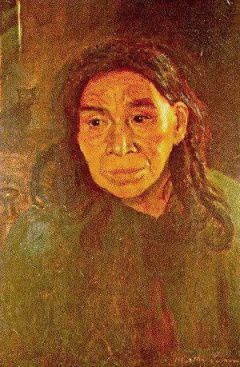
Martha Simon in March, the last of Narragansett 1857 by Albert Bierstadt (German-born American painter, 1830-1902)

Albert Bierstadt (German-born American painter, 1830-1902) Martha Simon in March, the last of Narragansett (1857)


Albert Bierstadt (German-born American painter, 1830-1902) was best known for his lavish, sweeping landscapes of the American West. To paint the scenes, Bierstadt joined several journeys of the Westward Expansion. Bierstadt, was born in Solingen, Germany. He was still a toddler, when his family moved from Germany to New Bedford in Massachusetts. In 1853, he returned to Germany to study in Dusseldorf, where he refined his technical abilities by painting Alpine landscapes. After he returned to America in 1857, he joined an overland survey expedition traveling westward across the country. Along the route, he took countless photographs & made sketches & returned East to paint from them. He exhibited at the Boston Athenaeum from 1859-1864, at the Brooklyn Art Association from 1861-1879, & at the Boston Art Club from 1873-1880. A member of the National Academy of Design from 1860-1902, he kept a studio in the 10th Street Studio Building, New York City from 1861-1879. He was a member of the Century Association from 1862-1902, when he died.