
Tuesday, October 29, 2019
Paul Kane (1810–1871) Return of a War Party in Canada, 1847

Sunday, October 27, 2019
Pacific Coast Ohlone Indian 1816 by Louis Choris (1795-1828)
Ohlone people, also known as the Costanoan, are a Native American people of the central & northern California coast. When Spanish explorers & missionaries arrived in the late 18th century, the Ohlone inhabited the area along the coast from San Francisco Bay through Monterey Bay to the lower Salinas Valley. They lived by hunting, fishing, & gathering, in the typical ethnographic California pattern. The members of these various bands interacted freely with one another as they built friendships & marriages, traded tools & other necessities, & partook in cultural practices. Before the Spanish came, the northern California region was one of the most densely populated regions north of Mexico. However in the years 1769 to 1833, the Spanish missions in California had a devastating effect on Ohlone culture. The Ohlone population declined steeply during this period.
 Louis Choris (German-Russian painter 1795-1828) Ohlone Indian 1816
Louis Choris (1795-1828) was a German-Russian painter & explorer. He was one of the 1st sketch artists used for for expedition research. Choris, who was a Russian of German stock, was born in Yekaterinoslav, now Dnipropetrovsk, Ukraine on March 22, 1795. He visited the Pacific coast of North America in 1816, on board the Ruric, being attached in the capacity of artist to the Romanzoff expedition under the command of Lieutenant Otto von Kotzebue, sent out for the purpose of exploring a Northwest Passage. After the voyage, Choris went to Paris, where he issued a portfolio of his drawings in lithographic reproduction. Choris worked extensively in pastels, as he documented the Ohlone people in the missions of San Francisco, California in 1816. Voyage Pittoresque Autour du Monde, Avec des Portraits de Savages d'Amerique...by Louis Choriswas was published in Paris by Firmin Didot in 1822. Choris was only 20 years old, when he was appointed official artist aboard the Rurik, 1815- 1818, commanded by the Russian, Otto von Kotzebue. After visiting islands in the South Seas, Kotzebue explored the North American coast & landed twice on the Hawaiian Islands. The first work in particular has great American interest because of its lithographs of California, the Queen Charlotte Islands, the Aleutians, St. Lawrence Island in the Bering Sea, & Kotzebue Sound in Alaska. The lithographs cover all aspects of native life & culture.
Louis Choris (1795-1828) was a German-Russian painter & explorer. He was one of the 1st sketch artists used for for expedition research. Choris, who was a Russian of German stock, was born in Yekaterinoslav, now Dnipropetrovsk, Ukraine on March 22, 1795. He visited the Pacific coast of North America in 1816, on board the Ruric, being attached in the capacity of artist to the Romanzoff expedition under the command of Lieutenant Otto von Kotzebue, sent out for the purpose of exploring a Northwest Passage. After the voyage, Choris went to Paris, where he issued a portfolio of his drawings in lithographic reproduction. Choris worked extensively in pastels, as he documented the Ohlone people in the missions of San Francisco, California in 1816. Voyage Pittoresque Autour du Monde, Avec des Portraits de Savages d'Amerique...by Louis Choriswas was published in Paris by Firmin Didot in 1822. Choris was only 20 years old, when he was appointed official artist aboard the Rurik, 1815- 1818, commanded by the Russian, Otto von Kotzebue. After visiting islands in the South Seas, Kotzebue explored the North American coast & landed twice on the Hawaiian Islands. The first work in particular has great American interest because of its lithographs of California, the Queen Charlotte Islands, the Aleutians, St. Lawrence Island in the Bering Sea, & Kotzebue Sound in Alaska. The lithographs cover all aspects of native life & culture.
Friday, October 25, 2019

Wednesday, October 23, 2019
Indian Stick Game at Mission Dolores 1822 by Louis Choris (1795-1828)
Ohlone people, also known as the Costanoan, are a Native American people of the central & northern California coast. When Spanish explorers & missionaries arrived in the late 18th century, the Ohlone inhabited the area along the coast from San Francisco Bay through Monterey Bay to the lower Salinas Valley. They lived by hunting, fishing, & gathering, in the typical ethnographic California pattern. The members of these various bands interacted freely with one another as they built friendships & marriages, traded tools & other necessities, & partook in cultural practices. Before the Spanish came, the northern California region was one of the most densely populated regions north of Mexico. However in the years 1769 to 1833, the Spanish missions in California had a devastating effect on Ohlone culture. The Ohlone population declined steeply during this period.
 Louis Choris (German-Russian painter 1795-1828) Indian Stick Game at Mission Dolores 1822
Louis Choris (1795-1828) was a German-Russian painter & explorer. He was one of the 1st sketch artists used for for expedition research. Choris, who was a Russian of German stock, was born in Yekaterinoslav, now Dnipropetrovsk, Ukraine on March 22, 1795. He visited the Pacific coast of North America in 1816, on board the Ruric, being attached in the capacity of artist to the Romanzoff expedition under the command of Lieutenant Otto von Kotzebue, sent out for the purpose of exploring a Northwest Passage. After the voyage, Choris went to Paris, where he issued a portfolio of his drawings in lithographic reproduction. Choris worked extensively in pastels, as he documented the Ohlone people in the missions of San Francisco, California in 1816. Voyage Pittoresque Autour du Monde, Avec des Portraits de Savages d'Amerique...by Louis Choriswas was published in Paris by Firmin Didot in 1822. Choris was only 20 years old, when he was appointed official artist aboard the Rurik, 1815- 1818, commanded by the Russian, Otto von Kotzebue. After visiting islands in the South Seas, Kotzebue explored the North American coast & landed twice on the Hawaiian Islands. The first work in particular has great American interest because of its lithographs of California, the Queen Charlotte Islands, the Aleutians, St. Lawrence Island in the Bering Sea, & Kotzebue Sound in Alaska. The lithographs cover all aspects of native life & culture.
Louis Choris (1795-1828) was a German-Russian painter & explorer. He was one of the 1st sketch artists used for for expedition research. Choris, who was a Russian of German stock, was born in Yekaterinoslav, now Dnipropetrovsk, Ukraine on March 22, 1795. He visited the Pacific coast of North America in 1816, on board the Ruric, being attached in the capacity of artist to the Romanzoff expedition under the command of Lieutenant Otto von Kotzebue, sent out for the purpose of exploring a Northwest Passage. After the voyage, Choris went to Paris, where he issued a portfolio of his drawings in lithographic reproduction. Choris worked extensively in pastels, as he documented the Ohlone people in the missions of San Francisco, California in 1816. Voyage Pittoresque Autour du Monde, Avec des Portraits de Savages d'Amerique...by Louis Choriswas was published in Paris by Firmin Didot in 1822. Choris was only 20 years old, when he was appointed official artist aboard the Rurik, 1815- 1818, commanded by the Russian, Otto von Kotzebue. After visiting islands in the South Seas, Kotzebue explored the North American coast & landed twice on the Hawaiian Islands. The first work in particular has great American interest because of its lithographs of California, the Queen Charlotte Islands, the Aleutians, St. Lawrence Island in the Bering Sea, & Kotzebue Sound in Alaska. The lithographs cover all aspects of native life & culture.
Saturday, October 19, 2019
Louisiana Native Americans by French-born François Bernard 1812–c 1880
Portrait, landscape, & genre painter, Francois Bernard is known in Louisiana primarily for his portraits in oil, pastel, & watercolor. He was probably born Nimes, France.
 François Bernard (French-born Louisiana painter, 1812–a 1880) Choctaw Village Near Chefuncte
He studied at the Ecole des Beaux Arts at Paris & Collin' & exhibited in the Paris salon between 1842 & 1849. His portraits of Louisiana residents are dated as early as 1848, when he apparently was visiting. Bernard returned in Dec. 1856, to settle in New Orleans, supposedly at the invitation of a group of sugar planters who wanted him to paint their portraits. He worked in New Orleans during the winter months & traveled as an itinerant painter in the summer. It is probable that Bernard returned to France during these travels, since his children were born there (ca. 1857 & ca. 1862). He seems to have left New Orleans during the Civil War & traveled, especially around Mandeville, Louisiana, where he painted local Native Americans. In February of 1867, it was reported that he had returned to the city.
 François Bernard (French-born Louisiana painter, 1812–a 1880) Two Chitimacha Indians
He exhibited in New Orleans at Wageners in 1867; at the Grand State Fair in 1868; at Wagener & Meyer's from 1869-71; & at the American Exposition from 1885-6. About 1875, Bernard left New Orleans for Peru.
He studied at the Ecole des Beaux Arts at Paris & Collin' & exhibited in the Paris salon between 1842 & 1849. His portraits of Louisiana residents are dated as early as 1848, when he apparently was visiting. Bernard returned in Dec. 1856, to settle in New Orleans, supposedly at the invitation of a group of sugar planters who wanted him to paint their portraits. He worked in New Orleans during the winter months & traveled as an itinerant painter in the summer. It is probable that Bernard returned to France during these travels, since his children were born there (ca. 1857 & ca. 1862). He seems to have left New Orleans during the Civil War & traveled, especially around Mandeville, Louisiana, where he painted local Native Americans. In February of 1867, it was reported that he had returned to the city.
He exhibited in New Orleans at Wageners in 1867; at the Grand State Fair in 1868; at Wagener & Meyer's from 1869-71; & at the American Exposition from 1885-6. About 1875, Bernard left New Orleans for Peru.
Thursday, October 17, 2019
Inkpaduta (Scarlet Point) (c 1805–c 1879) - Wahpekute Dakota Indian chief
Inkpaduta (Scarlet Point) (c 1805–c 1879) by William E. Lass
Inkpaduta (Scarlet Point) (c 1805–c 1879) was a Wahpekute Dakota Indian chief and perpetrator of the so-called Spirit Lake Massacre, the principal clash between American Indians and whites in Iowa's history—was the son of chief Wamdisapa. When Inkpaduta was born in present-day southern Minnesota, the Wahpekute, numbering only about 550, ranged out of their main village near present-day Faribault, Minnesota, to hunt and trap. Their conditions were worsened by traditional warfare with the Sauk and Meskwaki to their south and by the disastrous 1837 smallpox epidemic.

Because Inkpaduta did not participate in the 1851 treaties under which the Dakota (Eastern or Santee Sioux) ceded their lands in Minnesota and Iowa for annual government payments and reservations on the upper Minnesota River, his band had to continue to live off the land. Subsistence became much more difficult as whites began to settle northwest of Fort Dodge. Pioneers' complaints about begging and stealing by followers of Inkpaduta and Sintomniduta, a brother-in-law of the prominent Sisseton Dakota chief Sleepy Eyes, exacerbated tensions.
Relations deteriorated further after the murder of Sintomniduta by a white ruffian and the government's abandonment of three-year-old Fort Dodge in 1853. Threatened with starvation in the cold, snowy winter of 1856-1857, Inkpaduta and his dozen or so men killed some settlers between West Okoboji Lake and East Okoboji Lake on March 8, 1857. Within a few days, they killed 32 settlers. The affair was soon widely publicized as the Spirit Lake Massacre, because the entire lake complex was historically identified only as "Spirit Lake."
While Inkpaduta's band was escaping to the west, fear of a general Indian uprising gripped the Iowa-Minnesota frontier. Panicky newspaper editors made Inkpaduta an instant villainous celebrity. Although Inkpaduta did not play a significant role in Minnesota's Indian War of 1862, in which some 450 settlers were slain, the government's failure to apprehend him helped cause it. Some Dakota concluded that the government was incapable of responding to Indian attacks.
The army's offensive in Minnesota caused hundreds of Dakota to flee into Dakota Territory and Canada. Sympathy for their cause and white incursions during the Montana gold rush caused the Nakota (Middle Sioux) and Lakota (Western or Teton Sioux) to expand hostilities. When the federal government sent several thousand troops into Dakota Territory, Inkpaduta and his band were living with the Yanktonai, a branch of the Nakota. Inkpaduta participated in Sioux defeats at White Stone Hill (September 3, 1863) and Killdeer Mountain (July 28, 1864).
After the Killdeer Mountain setback, Inkpaduta became associated with Sitting Bull, prominent medicine man of the Hunkpapa Lakota. Inkpaduta was involved in the Lakota resistance to white advances in the upper Missouri country for over a decade before the epochal Great Sioux War of 1876. During that conflict, he was at the Battle of the Little Bighorn in which Sitting Bull and Crazy Horse led the annihilation of Lieutenant Colonel George Armstrong Custer's 220-man command. The aged and blind Inkpaduta did not participate in the fighting, but two of his sons distinguished themselves.
After the battle, Inkpaduta fled to Canada. He died several years later in the vicinity of present-day Brandon, Manitoba. Inkpaduta's reputation has been somewhat resurrected by recent historical reinterpretation that places more emphasis on his uncompromising resistance to the white takeover of Indian lands.
Sources A short scholarly biography of Inkpaduta is in Mark Diedrich, Famous Chiefs of the Eastern Sioux (1987). Another well-researched account is Peggy Rodina Larson, "A New Look at the Elusive Inkpaduta," Minnesota History 48 (1982), 24–35, derived from her master's thesis, "Inkpaduta-Renegade Sioux" (Mankato State College, 1969). The most detailed coverage of the Spirit Lake Massacre is in F. I. Harriott's five-part article in Annals of Iowa 18 (1932–1933), 243–94, 323– 82, 434–70, 483–517, 597–628; Abbie Gardner-Sharp, History of the Spirit Lake Massacre and Captivity of Miss Abbie Gardner (1885); and Thomas Teakle, The Spirit Lake Massacre (1918). The hysteria caused by the Spirit Lake Massacre and inconsistencies in firsthand accounts about it are presented in Mary Hawker Bakeman, ed., Legends, Letters and Lies: Readings about Inkpaduta and the Spirit Lake Massacre (2001). The only full-length biography, Maxwell Van Nuys, Inkpaduta- The Scarlet Point: Terror of the Dakota Frontier and Secret Hero of the Sioux (1998), is flawed by numerous errors, suppositions, and bias.
Research by Lass, William E. "Inkpaduta (Scarlet Point)" The Biographical Dictionary of Iowa. University of Iowa Press, 2009.
Inkpaduta (Scarlet Point) (c 1805–c 1879) was a Wahpekute Dakota Indian chief and perpetrator of the so-called Spirit Lake Massacre, the principal clash between American Indians and whites in Iowa's history—was the son of chief Wamdisapa. When Inkpaduta was born in present-day southern Minnesota, the Wahpekute, numbering only about 550, ranged out of their main village near present-day Faribault, Minnesota, to hunt and trap. Their conditions were worsened by traditional warfare with the Sauk and Meskwaki to their south and by the disastrous 1837 smallpox epidemic.

Tasagi, the leading Wahpekute chief, favored ceding tribal lands to the federal government under the abortive 1841 Doty Treaty. Possibly because of tribal contention over the agreement, Tasagi was murdered. Inkpaduta was complicit enough to be forced into exile by Tasagi's adherents. For the next 16 years Inkpaduta and his small band hunted, trapped, and foraged in present-day northwestern Iowa, southwestern Minnesota, and southeastern South Dakota.
Because Inkpaduta did not participate in the 1851 treaties under which the Dakota (Eastern or Santee Sioux) ceded their lands in Minnesota and Iowa for annual government payments and reservations on the upper Minnesota River, his band had to continue to live off the land. Subsistence became much more difficult as whites began to settle northwest of Fort Dodge. Pioneers' complaints about begging and stealing by followers of Inkpaduta and Sintomniduta, a brother-in-law of the prominent Sisseton Dakota chief Sleepy Eyes, exacerbated tensions.
Relations deteriorated further after the murder of Sintomniduta by a white ruffian and the government's abandonment of three-year-old Fort Dodge in 1853. Threatened with starvation in the cold, snowy winter of 1856-1857, Inkpaduta and his dozen or so men killed some settlers between West Okoboji Lake and East Okoboji Lake on March 8, 1857. Within a few days, they killed 32 settlers. The affair was soon widely publicized as the Spirit Lake Massacre, because the entire lake complex was historically identified only as "Spirit Lake."
While Inkpaduta's band was escaping to the west, fear of a general Indian uprising gripped the Iowa-Minnesota frontier. Panicky newspaper editors made Inkpaduta an instant villainous celebrity. Although Inkpaduta did not play a significant role in Minnesota's Indian War of 1862, in which some 450 settlers were slain, the government's failure to apprehend him helped cause it. Some Dakota concluded that the government was incapable of responding to Indian attacks.
The army's offensive in Minnesota caused hundreds of Dakota to flee into Dakota Territory and Canada. Sympathy for their cause and white incursions during the Montana gold rush caused the Nakota (Middle Sioux) and Lakota (Western or Teton Sioux) to expand hostilities. When the federal government sent several thousand troops into Dakota Territory, Inkpaduta and his band were living with the Yanktonai, a branch of the Nakota. Inkpaduta participated in Sioux defeats at White Stone Hill (September 3, 1863) and Killdeer Mountain (July 28, 1864).
After the Killdeer Mountain setback, Inkpaduta became associated with Sitting Bull, prominent medicine man of the Hunkpapa Lakota. Inkpaduta was involved in the Lakota resistance to white advances in the upper Missouri country for over a decade before the epochal Great Sioux War of 1876. During that conflict, he was at the Battle of the Little Bighorn in which Sitting Bull and Crazy Horse led the annihilation of Lieutenant Colonel George Armstrong Custer's 220-man command. The aged and blind Inkpaduta did not participate in the fighting, but two of his sons distinguished themselves.
After the battle, Inkpaduta fled to Canada. He died several years later in the vicinity of present-day Brandon, Manitoba. Inkpaduta's reputation has been somewhat resurrected by recent historical reinterpretation that places more emphasis on his uncompromising resistance to the white takeover of Indian lands.
Sources A short scholarly biography of Inkpaduta is in Mark Diedrich, Famous Chiefs of the Eastern Sioux (1987). Another well-researched account is Peggy Rodina Larson, "A New Look at the Elusive Inkpaduta," Minnesota History 48 (1982), 24–35, derived from her master's thesis, "Inkpaduta-Renegade Sioux" (Mankato State College, 1969). The most detailed coverage of the Spirit Lake Massacre is in F. I. Harriott's five-part article in Annals of Iowa 18 (1932–1933), 243–94, 323– 82, 434–70, 483–517, 597–628; Abbie Gardner-Sharp, History of the Spirit Lake Massacre and Captivity of Miss Abbie Gardner (1885); and Thomas Teakle, The Spirit Lake Massacre (1918). The hysteria caused by the Spirit Lake Massacre and inconsistencies in firsthand accounts about it are presented in Mary Hawker Bakeman, ed., Legends, Letters and Lies: Readings about Inkpaduta and the Spirit Lake Massacre (2001). The only full-length biography, Maxwell Van Nuys, Inkpaduta- The Scarlet Point: Terror of the Dakota Frontier and Secret Hero of the Sioux (1998), is flawed by numerous errors, suppositions, and bias.
Research by Lass, William E. "Inkpaduta (Scarlet Point)" The Biographical Dictionary of Iowa. University of Iowa Press, 2009.
Monday, September 23, 2019
Native Americans by Cassilly Adams (1843-1921)


A descendant of President John Adams, Kassilli or Cassilly Adams (1843-1921) was born in Zanesville, Ohio. His father, William Adams, was an amateur painter. Young Cassilly studied painting at the Academy of Art in Boston and Cincinnati Art School. During the Civil War he served in the US Navy.
From Europe to the Atlantic coast of America & on to the Pacific coast during the 17C-19C, settlers moved West encountering a variety of Indigenous Peoples who had lived on the land for centuries.
By 1880, Adams was living in St. Louis. In 1884, the artist created a monumental canvas depicting the Battle of the Little Bighorn (death of the Seventh Cavalry Regiment of the US Army and its famous commander George Custer) - "Custer's Last Fight." The painting was exhibited across the country, and then was purchased by the company "Anheuser-Busch" and later donated to the Seventh Cavalry. After the restoration of the original during the Great Depression, it was exhibited in the officers' club at Fort Bliss (Texas), and June 13, 1946 was burned in a fire. Despite the success of "Custer's Last Fight," Adams remained a relatively unknown artist. He focused on the image of Indians American West Plains life, worked as an illustrator, a farmer. He died Kassilli Adams May 8, 1921 in Traders Point near Indianapolis.
Saturday, September 21, 2019
American artist Seth Eastman (1808-1875) portrays Native Americans

Born in 1808 in Brunswick, Maine, Seth Eastman (1808-1875) found expression for his artistic skills in a military career. After graduating from the US Military Academy at West Point, where officers-in-training were taught basic drawing & drafting techniques, Eastman was posted to forts in Wisconsin & Minnesota before returning to West Point as assistant teacher of drawing. --- While at Fort Snelling, Eastman married Wakaninajinwin (Stands Sacred), the 15-year-old daughter of Cloud Man, Dakota chief. Eastman left in 1832, for another military assignment soon after the birth of their baby girl, Winona, & he declared his marriage ended when he left. Winona was also known as Mary Nancy Eastman & was the mother of Charles Alexander Eastman, author of Indian Boyhood. --- From 1833 to 1840, Eastman taught drawing at West Point. In 1835, he married his 2nd wife & was reassigned to Fort Snelling as a military commander & remained there with Mary & their 5 children for the next 7 years. During this time Eastman began recording the everyday way of life of the Dakota & the Ojibwa people. Transferred to posts in Florida, & Texas in the 1840s, Eastman made sketches of the native peoples there. This experience prepared him for the next 5 yeas in Washington, DC, where he was assigned to the commissioner of Indian Affairs & illustrated Henry Rowe Schoolcraft's important 6-volume Historical Statistical Information Respecting the History, Condition, & Prospects of the Indian Tribes of the United States. In 1867, Eastman returned to the Capitol to paint a series of scenes of Native American life for the House Committee on Indian Affairs. From the office of the United States Senate curator, we learn that in 1870, the House Committee on Military Affairs commissioned artist Seth Eastman 17 to paint images of important fortifications in the United States. He completed the works between 1870 & 1875. Of his 17 paintings of forts, 8 are located in the Senate, while the others are displayed on the House side of the Capitol. Eastman was working on the painting West Point, when he died in 1875.
Thursday, September 19, 2019
Mariposa Indian Encampment, Yosemite Valley, California by Albert Bierstadt (German-born American painter, 1830-1902)
From Europe to the Atlantic coast of America & on to the Pacific coast during the 17C-19C, settlers moved West encountering a variety of Indigenous Peoples who had lived on the land for centuries.
 Albert Bierstadt (German-born American painter, 1830-1902) Mariposa Indian Encampment, Yosemite Valley, California
California and the Indian Wars: Mariposa Indian War, 1850-1851
by Warren A. Beck and Ynez D. Hasse
The Mariposa Indian War was the most famed Indian encounter with miners in the southern Sierra region and also led to the discovery of Yosemite Valley. In 1849, as gold seekers invaded the country immediately west of the present Yosemite National Park they found one of the more densely populated Indian areas of the state. This was a region where acorns were abundant and game was plentiful below the winter snow line. Unfortunately, gold was also easily found along the numerous mountain strearns. At first the Indians (mainly Mono Piutes) welcomed the white man and the goods which could be obtained by trade, but resentment grew as virtually every valley was taken over by the newcomers.
To a certain extent, the story of this clash between Indian and white is the saga of James D. Savage, one of the most remarkable of the many characters of the Gold Rush era. A tall blue-eyed blonde who always wore red shirts to better impress the Indians, Savage had been a Bear Flagger, a one-time Sutter employee, and the one who was reported to have excited San Franciscans by hauling a barrel of gold dust through a hotel lobby. Establishing trading posts on the Fresno River and Mariposa Creek, he reportedly traded to the Indians "an ounce of gold [for] ... five pounds of flour, or a pound of bacon, a shirt required five ounces, and a pair of boots or a hat brought a full pound of the precious metal." Something of a linguist, Savage quickly learned most of the Indian tongues. He further ingratiated himself by taking wives from several different tribes (one authority said thirty-three!). It is hard to determine if the initial Indian attack was directed against Savage or against whites in general.
Through his wives Savage learned of a planned Indian uprising in September, 1850, but other whites did not take the warning seriously. In December, Savage's Trading Post was destroyed at Fresno Crossing, and three of his men killed. A force under Sheriff James Burney clashed indcisively with the Indians on January 11, 1851. An appeal to the Governor for help led to the organization of the Mariposa Battalion under "Major" James D. Savage, with three companies led by Captain John J. Kuykendall, Captain John Boling, and Captain William Dill. Kuykendall's company went southward to the King and upper Kaweah while the other two companies, in three campaigns, followed the Indians into the mountains.
The Mariposa Battalion was forced to wait before attacking the Indians while. a federal Indian commission, composed of Redick McKee, George W. Barbour, and Oliver M. Wozencraft, sought a peaceful solution. On March 19, 1851, the Commissioners signed a treaty at Camp Fremont with six tribes. However, the Yosemites (Miwok) and Chowchillas (Yokut) were absent, so the campaign against them began on March 19. The companies of Boling and Dill moved against the Yosemites, and discovered their valley on March 27. However, the battalion was forced to march in 3- to 5-foot snow drifts and in rain and sleet and found few Indians. The second campaign began on April 13, against the Chowchillas, and destroyed Indian food stores, but again the natives were able to elude their pursuers. However, the death of their chief induced the Chowchillas to surrender and accept reservation stattus. When the Yosemites refused to come to Camp Barbour and make peace, the third campaign launched against them, but with no more success than the others. However, as in all Indian wars the result was foreordained; the Yosemites were captured at Lake Tenaija (or Tenaya, named for their chief) on May 22, and forced to accept reservation life.
The artist Albert Bierstadt (German-born American, 1830-1902) was best known for his lavish, sweeping landscapes of the American West. To paint the scenes, Bierstadt joined several journeys of the Westward Expansion. Bierstadt, was born in Solingen, Germany. He was still a toddler, when his family moved from Germany to New Bedford in Massachusetts. In 1853, he returned to Germany to study in Dusseldorf, where he refined his technical abilities by painting Alpine landscapes. After he returned to America in 1857, he joined an overland survey expedition traveling westward across the country. Along the route, he took countless photographs & made sketches & returned East to paint from them. He exhibited at the Boston Athenaeum from 1859-1864, at the Brooklyn Art Association from 1861-1879, & at the Boston Art Club from 1873-1880. A member of the National Academy of Design from 1860-1902, he kept a studio in the 10th Street Studio Building, New York City from 1861-1879. He was a member of the Century Association from 1862-1902, when he died.
California and the Indian Wars: Mariposa Indian War, 1850-1851
by Warren A. Beck and Ynez D. Hasse
The Mariposa Indian War was the most famed Indian encounter with miners in the southern Sierra region and also led to the discovery of Yosemite Valley. In 1849, as gold seekers invaded the country immediately west of the present Yosemite National Park they found one of the more densely populated Indian areas of the state. This was a region where acorns were abundant and game was plentiful below the winter snow line. Unfortunately, gold was also easily found along the numerous mountain strearns. At first the Indians (mainly Mono Piutes) welcomed the white man and the goods which could be obtained by trade, but resentment grew as virtually every valley was taken over by the newcomers.
To a certain extent, the story of this clash between Indian and white is the saga of James D. Savage, one of the most remarkable of the many characters of the Gold Rush era. A tall blue-eyed blonde who always wore red shirts to better impress the Indians, Savage had been a Bear Flagger, a one-time Sutter employee, and the one who was reported to have excited San Franciscans by hauling a barrel of gold dust through a hotel lobby. Establishing trading posts on the Fresno River and Mariposa Creek, he reportedly traded to the Indians "an ounce of gold [for] ... five pounds of flour, or a pound of bacon, a shirt required five ounces, and a pair of boots or a hat brought a full pound of the precious metal." Something of a linguist, Savage quickly learned most of the Indian tongues. He further ingratiated himself by taking wives from several different tribes (one authority said thirty-three!). It is hard to determine if the initial Indian attack was directed against Savage or against whites in general.
Through his wives Savage learned of a planned Indian uprising in September, 1850, but other whites did not take the warning seriously. In December, Savage's Trading Post was destroyed at Fresno Crossing, and three of his men killed. A force under Sheriff James Burney clashed indcisively with the Indians on January 11, 1851. An appeal to the Governor for help led to the organization of the Mariposa Battalion under "Major" James D. Savage, with three companies led by Captain John J. Kuykendall, Captain John Boling, and Captain William Dill. Kuykendall's company went southward to the King and upper Kaweah while the other two companies, in three campaigns, followed the Indians into the mountains.
The Mariposa Battalion was forced to wait before attacking the Indians while. a federal Indian commission, composed of Redick McKee, George W. Barbour, and Oliver M. Wozencraft, sought a peaceful solution. On March 19, 1851, the Commissioners signed a treaty at Camp Fremont with six tribes. However, the Yosemites (Miwok) and Chowchillas (Yokut) were absent, so the campaign against them began on March 19. The companies of Boling and Dill moved against the Yosemites, and discovered their valley on March 27. However, the battalion was forced to march in 3- to 5-foot snow drifts and in rain and sleet and found few Indians. The second campaign began on April 13, against the Chowchillas, and destroyed Indian food stores, but again the natives were able to elude their pursuers. However, the death of their chief induced the Chowchillas to surrender and accept reservation stattus. When the Yosemites refused to come to Camp Barbour and make peace, the third campaign launched against them, but with no more success than the others. However, as in all Indian wars the result was foreordained; the Yosemites were captured at Lake Tenaija (or Tenaya, named for their chief) on May 22, and forced to accept reservation life.
The artist Albert Bierstadt (German-born American, 1830-1902) was best known for his lavish, sweeping landscapes of the American West. To paint the scenes, Bierstadt joined several journeys of the Westward Expansion. Bierstadt, was born in Solingen, Germany. He was still a toddler, when his family moved from Germany to New Bedford in Massachusetts. In 1853, he returned to Germany to study in Dusseldorf, where he refined his technical abilities by painting Alpine landscapes. After he returned to America in 1857, he joined an overland survey expedition traveling westward across the country. Along the route, he took countless photographs & made sketches & returned East to paint from them. He exhibited at the Boston Athenaeum from 1859-1864, at the Brooklyn Art Association from 1861-1879, & at the Boston Art Club from 1873-1880. A member of the National Academy of Design from 1860-1902, he kept a studio in the 10th Street Studio Building, New York City from 1861-1879. He was a member of the Century Association from 1862-1902, when he died.
Tuesday, September 17, 2019
Breaking up Camp at Sunrise by Alfred Jacob Miller (1810-1874)

At four o'clock in the morning, it is the duty of the last men on guard to loosen the horses from their pickets, in order to range and feed. At daylight, everybody is up;- our provisors are busy with preparations for breakfast;- tents and lodges are collapsed, suddenly thrown down, wrapped up, and bundled into the wagons. If the sun is 20 minutes above the horizon when our breakfast is finished, we conceive he has a reproachful look. By this time the horses are driven in, and each man hurries after his own, saddles or harnesses him, and the train puts itself en route." A.J. Miller, extracted from "The West of Alfred Jacob Miller" (1837).
In July of 1858, Baltimore art collector William T. Walters commissioned 200 watercolors at $12 apiece from Baltimore-born artist Alfred Jacob Miller. These paintings were each accompanied by a descriptive text written by the artist, & were delivered in installments over the next 21 months & ultimately bound in 3 albums. These albums included the field-sketches drawn during Miller's 1837 expedition to the annual fur-trader's rendezvous in the Green River Valley (now western Wyoming). These watercolors offer a unique record of the the lives of those involved in the closing years of the western fur trade & a look at the artist's opinions of both women & Native Americans. The Walters Art Museum, Baltimore, Maryland.
Friday, September 13, 2019
Pacific Coast Ohlone & Costanoan Native Americans by Louis Choris (1795-1828)
Ohlone people, also known as the Costanoan, are a Native American people of the central & northern California coast. When Spanish explorers & missionaries arrived in the late 18th century, the Ohlone inhabited the area along the coast from San Francisco Bay through Monterey Bay to the lower Salinas Valley. They lived by hunting, fishing, & gathering, in the typical ethnographic California pattern. The members of these various bands interacted freely with one another as they built friendships & marriages, traded tools & other necessities, & partook in cultural practices. Before the Spanish came, the northern California region was one of the most densely populated regions north of Mexico. However in the years 1769 to 1833, the Spanish missions in California had a devastating effect on Ohlone culture. The Ohlone population declined steeply during this period.
 Louis Choris (1795-1828) Indian Hunting in the Bay Of San Francisco, CA 1822 Engraved by Jean Augustin Franquein (1789-1839)
Louis Choris (1795-1828) was a German-Russian painter & explorer. He was one of the 1st sketch artists used for for expedition research. Choris, who was a Russian of German stock, was born in Yekaterinoslav, now Dnipropetrovsk, Ukraine on March 22, 1795. He visited the Pacific coast of North America in 1816, on board the Ruric, being attached in the capacity of artist to the Romanzoff expedition under the command of Lieutenant Otto von Kotzebue, sent out for the purpose of exploring a Northwest Passage. After the voyage, Choris went to Paris, where he issued a portfolio of his drawings in lithographic reproduction. Choris worked extensively in pastels, as he documented the Ohlone people in the missions of San Francisco, California in 1816. Voyage Pittoresque Autour du Monde, Avec des Portraits de Savages d'Amerique...by Louis Choriswas was published in Paris by Firmin Didot in 1822. Choris was only 20 years old, when he was appointed official artist aboard the Rurik, 1815- 1818, commanded by the Russian, Otto von Kotzebue. After visiting islands in the South Seas, Kotzebue explored the North American coast & landed twice on the Hawaiian Islands. The first work in particular has great American interest because of its lithographs of California, the Queen Charlotte Islands, the Aleutians, St. Lawrence Island in the Bering Sea, & Kotzebue Sound in Alaska. The lithographs cover all aspects of native life & culture.
Louis Choris (1795-1828) was a German-Russian painter & explorer. He was one of the 1st sketch artists used for for expedition research. Choris, who was a Russian of German stock, was born in Yekaterinoslav, now Dnipropetrovsk, Ukraine on March 22, 1795. He visited the Pacific coast of North America in 1816, on board the Ruric, being attached in the capacity of artist to the Romanzoff expedition under the command of Lieutenant Otto von Kotzebue, sent out for the purpose of exploring a Northwest Passage. After the voyage, Choris went to Paris, where he issued a portfolio of his drawings in lithographic reproduction. Choris worked extensively in pastels, as he documented the Ohlone people in the missions of San Francisco, California in 1816. Voyage Pittoresque Autour du Monde, Avec des Portraits de Savages d'Amerique...by Louis Choriswas was published in Paris by Firmin Didot in 1822. Choris was only 20 years old, when he was appointed official artist aboard the Rurik, 1815- 1818, commanded by the Russian, Otto von Kotzebue. After visiting islands in the South Seas, Kotzebue explored the North American coast & landed twice on the Hawaiian Islands. The first work in particular has great American interest because of its lithographs of California, the Queen Charlotte Islands, the Aleutians, St. Lawrence Island in the Bering Sea, & Kotzebue Sound in Alaska. The lithographs cover all aspects of native life & culture.
Monday, September 9, 2019
American artist Seth Eastman (1808-1875) portrays Wah-ba-sha Village on the Mississippi River 650 Miles above St. Louis

Born in 1808 in Brunswick, Maine, Seth Eastman (1808-1875) found expression for his artistic skills in a military career. After graduating from the US Military Academy at West Point, where officers-in-training were taught basic drawing & drafting techniques, Eastman was posted to forts in Wisconsin & Minnesota before returning to West Point as assistant teacher of drawing. --- While at Fort Snelling, Eastman married Wakaninajinwin (Stands Sacred), the 15-year-old daughter of Cloud Man, Dakota chief. Eastman left in 1832, for another military assignment soon after the birth of their baby girl, Winona, & he declared his marriage ended when he left. Winona was also known as Mary Nancy Eastman & was the mother of Charles Alexander Eastman, author of Indian Boyhood. --- From 1833 to 1840, Eastman taught drawing at West Point. In 1835, he married his 2nd wife & was reassigned to Fort Snelling as a military commander & remained there with Mary & their 5 children for the next 7 years. During this time Eastman began recording the everyday way of life of the Dakota & the Ojibwa people. Transferred to posts in Florida, & Texas in the 1840s, Eastman made sketches of the native peoples there. This experience prepared him for the next 5 yeas in Washington, DC, where he was assigned to the commissioner of Indian Affairs & illustrated Henry Rowe Schoolcraft's important 6-volume Historical Statistical Information Respecting the History, Condition, & Prospects of the Indian Tribes of the United States. In 1867, Eastman returned to the Capitol to paint a series of scenes of Native American life for the House Committee on Indian Affairs. From the office of the United States Senate curator, we learn that in 1870, the House Committee on Military Affairs commissioned artist Seth Eastman 17 to paint images of important fortifications in the United States. He completed the works between 1870 & 1875. Of his 17 paintings of forts, 8 are located in the Senate, while the others are displayed on the House side of the Capitol. Eastman was working on the painting West Point, when he died in 1875.
Saturday, September 7, 2019
Karl Ferdinand Wimar (1828-1862) The War Party

A German-born immigrant to the United States, Charles Wimar(1828-1862) was fascinated by the American frontier. In 1843, he traveled to St. Louis, a fur-trading frontier town at the time. Between 1846 & 1850, he was apprenticed to the artist Leon de Pomarede, & accompanied him on a journey up the Mississippi, to St. Anthony Falls in Minnesota. In 1852, Wimar returned to Germany; & for 4 years, he studied with with Emmanuel Leutze & Josef Fay in Düsseldorf. After his return to the United States, Wimar took several journeys up the Mississippi River and, in 1858, up the Yellowstone River – documented in various sketchbooks. When he died from tuberculosis at the age of 34, he left about 50 paintings. Wimar's paintings, like others of the time, reinforced notions of Native Americans as savage & white settlers as cultivated & divinely ordained - a notion that helped justify white colonization of the West.
Thursday, September 5, 2019
Alfred Jacob Miller (1810-1874) - Arapahos

"This scene represents an Arapaho Indian en famille, smoking his pipe and reposing under a blanket suspended from the branches of a tree, to screen them from the sun. We saw some fine speciments of this tribe. They do not shave their heads like the Sioux, but braid the centre or scalp lock with ribbons or feathers of the 'War Eagle.' We noticed also a difference in their moccasins, the fronts extending only to the instep and wanting the side flaps. Indians are capable of designating a tribe very often by merely having the moccasins. The Arapahos were tall, finely formed men, from 5 ft. 8 in. to 6 ft. in height. In setting out on their war parties, the process of painting, dressing, and adorning themselves occupies considerably of their time and attention. When a party is seen scouring over the prairies under thes circumstances it bodes no good to theose they happen to encounter. As regards their steeds, they have no geldings & we saw none, except those brought from the States. The animal thus preserves all his game spirit & is capable of great endurance. They partake somewhat of the Arabian breed." A.J. Miller, extracted from "The West of Alfred Jacob Miller" (1837).
In July of 1858, Baltimore art collector William T. Walters commissioned 200 watercolors at $12 apiece from Baltimore-born artist Alfred Jacob Miller. These paintings were each accompanied by a descriptive text written by the artist, & were delivered in installments over the next 21 months & ultimately bound in 3 albums. These albums included the field-sketches drawn during Miller's 1837 expedition to the annual fur-trader's rendezvous in the Green River Valley (now western Wyoming). These watercolors offer a unique record of the the lives of those involved in the closing years of the western fur trade & a look at the artist's opinions of both women & Native Americans. The Walters Art Museum, Baltimore, Maryland.
Tuesday, September 3, 2019
Alfred Jacob Miller (1810-1874) - Breakfast at Sunrise

Alfred Jacob Miller (American, 1810-1874) Breakfast at Sunrise
"The sketch represents 'our mess' at the morning meal;- Jean whi is pouring out coffee, seems to our hungry eyes more graceful than Hebe disposing Nectar, although he is more shapeless than a log of wood. The plate service of the table is of capital tin ware, partout, and the etiquette rigid in some particulars;- for instance, nothing in the shape of a fork must be used. With a 'Bowie' you separate a large rib from the mass before you, hold firmly to the smaller end, and your outrageous appetite teaches all the rest. The usual mode of sitting is cross-legged like a Turk. Indians are looking on patiently, in order to be ready for the 2nd table." A.J. Miller, extracted from "The West of Alfred Jacob Miller" (1837).
In July of 1858, Baltimore art collector William T. Walters commissioned 200 watercolors at $12 apiece from Baltimore-born artist Alfred Jacob Miller. These paintings were each accompanied by a descriptive text written by the artist, & were delivered in installments over the next 21 months & ultimately bound in 3 albums. These albums included the field-sketches drawn during Miller's 1837 expedition to the annual fur-trader's rendezvous in the Green River Valley (now western Wyoming). These watercolors offer a unique record of the the lives of those involved in the closing years of the western fur trade & a look at the artist's opinions of both women & Native Americans. The Walters Art Museum, Baltimore, Maryland.
Friday, August 30, 2019
Artist Karl Bodmer (1809-1893) Indian Capture of the Calloway Girls and Jemima Boone

Attributed to Karl Bodmer (Swiss Artist, 1809-1893) Capture of the Calloway Girls and Jemima Boone
On July 14, 1776, a raiding party caught 3 teenage girls from Boonesborough as they were floating in a canoe on the Kentucky River. They were Jemima, daughter of Daniel Boone, and Elizabeth and Frances, daughters of Colonel Richard Callaway. The Cherokee Hanging Maw led the raiders, 2 Cherokee and 3 Shawnee warriors. The girls' capture raised alarm and Boone organized a rescue party. Meanwhile, the captors hurried the girls north toward the Shawnee towns across the Ohio River. The girls attempted to mark their trail until threatened by the Indians. The 3rd morning, as the Indians were building a fire for breakfast, the rescuers came up. As one Indian was shot, Jemima reportedly said, "That's Father's gun!" He was not immediately killed, but two wounded Native American men later died. The Indians retreated, leaving the girls to be taken home by the settlers. The episode served to put the settlers in the Kentucky wilderness on guard and prevented their straying beyond the fort. Although the rescuers had feared the girls would be raped or otherwise abused, Jemima Boone said, "The Indians were kind to us, as much so as they well could have been, or their circumstances permitted." The Cherokee may have abducted the girls as a response to what they viewed as D. Boone's failure to observe Cherokee treaties. The Treaty of the Green River Wilderness promised Kentucky to Cherokee Tribe for "as long as the waters flow."
The artist Karl Bodmer (Swiss, 1809-1893) developed a remarkable talent for drawing & painting while studying with his uncle, painter & engraver Johann Jacob Meyer. After further studies in Paris, he joined his brother on a sketching trip through Germany in 1832 where he met Prince Maximilian zu Weid. Maximilian, known for his natural history research in the coastal forests of Brazil, was searching for a professional artist to accompany him on his expedition to North America. Bodmer signed a contract with Maximilian &, 3 weeks later, they set sail for America. From 1833-1834, the two traveled up the Missouri River, retracing the 1805 journey of Lewis & Clark. On the expedition, Bodmer depicted some of the same characters that George Caitlin had painted just months before. Bodmer was the last artist able to paint the Mandan Indians in North Dakota before the fatal 1837 smallpox epidemic that nearly obliterated the tribe. He also painted portraits of the Sioux, Blackfeet, Hidatsa, & other tribes, while Maximilian conducted studies & made notes on the botany & zoology of the areas. Before the end of the journey, Bodmer had completed 81 paintings, illustrating Maximilians expedition. Each elegant painting displayed extremely detailed & accurate accounts of Indian ceremonies & everyday life. In 1843, Maximilian's lithographs were published in Travels in the Interior of America.
Monday, August 26, 2019
Indians in Council by Albert Bierstadt (German-born American painter, 1830-1902)

Albert Bierstadt (German-born American painter, 1830-1902) The Indians on Board or in Council in California (c 1872)
Matthew Biagell explains in his book Albert Bierstadt that,"Athough Bierstadt made probing studies of individual Indians during his travels in the West, he usually generalized their appearances & activities in his paintings. He placed them, as he placed European peasants in earlier works, in the middle distance, so that we witness their presence in a landscape setting rather than focus on their movements." Many of his landscapes including Native Americans are the western equivalent of his European generalized landscapes & reveals Bierstadt's consistent attitude toward subject matter regardless of its locale human subjects are engaged in seemingly unrelated activities. His paintings, bathed in a golden glow, often suggest nostalgia for a previous age when Native Americans were thought to have lived harmoniously with nature. Here they are not wily, wicked, or predatory, but are engaged instead in peaceful domestic industry. Works such as this are obviously part of the broad western European tradition of Arcadian scenes, but in its American version the tradition assumes a particular complexity & ambivalence. His painting including Natives often portray the nobility of the Indians before their contact with Europeans & subsequent debasement. Paintings displaying this attitude undoubtedly provided the public with the images it wanted to see, especially during the years Indians were systematically being driven from their lands. Suchromanticized paintings might also be considered retardataire; the Indian, noble or otherwise, no longer engaged many serious 19C writers after the 1850s, & precise anthropological & linguistic analyses of Indian tribes were already being included in the Pacific railroad reports by that time.
Albert Bierstadt (German-born American painter, 1830-1902) was best known for these lavish, sweeping landscapes of the American West. To paint the scenes, Bierstadt joined several journeys of the Westward Expansion. Bierstadt, was born in Solingen, Germany. He was still a toddler, when his family moved from Germany to New Bedford in Massachusetts. In 1853, he returned to Germany to study in Dusseldorf, where he refined his technical abilities by painting Alpine landscapes. After he returned to America in 1857, he joined an overland survey expedition traveling westward across the country. Along the route, he took countless photographs & made sketches & returned East to paint from them. He exhibited at the Boston Athenaeum from 1859-1864, at the Brooklyn Art Association from 1861-1879, & at the Boston Art Club from 1873-1880. A member of the National Academy of Design from 1860-1902, he kept a studio in the 10th Street Studio Building, New York City from 1861-1879. He was a member of the Century Association from 1862-1902, when he died.
Sunday, August 25, 2019
Thomas Morton, Description of the Indians in New England (1637)


Of their Houses and Habitations.
The Natives of New England are accustomed to build them houses much like the wild Irish; they gather Poles in the woodes and put the great end of them in the ground, placing them in forme of a circle or circumference, and, bendinge the topps of them in forme of an Arch, they bind them together with the Barke of Walnut trees, which is wondrous tough, so that they make the same round on the Topp for the smoke of their fire to ascend and pass through; . . . The fire is alwayes made in the midst of the house, with winde falls commonly: yet some times they fell a tree that groweth near the house, and, by drawing in the end thereof, maintaine the fire on both sides, burning the tree by Degrees shorter and shorter, untill it be all consumed; for it burneth night and day. Their lodging is made in three places of the house about the fire; they Iie upon plankes, commonly about a foote or 18 inches above the ground, raised upon railes that are borne up upon forks; they lay mats under them, and Coats of Deares skinnes, otters, beavers, Racoons, and of Beares hides, all which they have dressed and converted into good leather, with the haire on, for their coverings: and in this manner they liee as warme as they desire. . . . for they are willing that any shall eat with them. Nay, if any one that shall come into their houses and there fall a sleepe, when they see him disposed to lie downe, they will spread a matt for him of their owne accord, and lay a roll of skinnes for a boulster, and let him lie. If he sleepe untill their meate be dished up, they will set a wooden bowl of meate by him that sleepeth, and wake him saying, Cattup keene Meckin: That is, If you be hungry, there is meat for you, where if you will eat you may. Such is their Humanity.
Likewise, when they are minded to remove, they carry away the mats with them; other materials the place adjoining will yield. They use not to winter and surnmer in one.place, for that would be a reason to make fuel scarce; but, after the manner of the gentry of Civilized natives, remove for their pleasures; some times to their hunting places, where they remaine keeping good hospitality for that season; and sometimes to their fishing places, where they abide for that season likewise; and at the spring, when fish comes in plentifully, they have meetinges from severall places, where they exercise themselves in gaming and playing of jugling trickes and all manner of Revelles, which they are delighted in; [so] that it is admirable to behold what pastime they use of severall kindes; every one striving to surpass each other. After this manner they spend their time. . . .
Of their Reverence, and Respect to Age.
It is a thing to be admired, and indeede made a president, that a Nation yet uncivilized should more respect age than some nations civilized, since there are so many precepts both of divine and humane writers extant to instruct more Civil Nations: in that particular, wherein they excel, the younger are always obedient unto the elder people, and at their commands in every respect without grumbling; in all councels, (as therein they are circumspect to do their actions by advise and councell, and not rashly or inconsiderately) the younger mens opinion shall be heard, but the old mens opinion and councell embraced and followed: besides, as the elder feede and provide for the younger in infancy, doe the younger, after being growne to years of manhood, provide for those that be aged; . . .
The consideration of these things, me thinks, should reduce some of our irregular young people of civilized Nations, when this story shall come to their knowledge, to better manners, and make them ashamed of their former error in this kinde, and to become hereafter more dutyfull; which I, as a friend, (by observation having found,) have herein recorded for that purpose. . . .
Of their Trafficke and Trade One With Another.
Although these people have not the use of navigation, whereby they may trafficke as other nations, that are civilized, use to doe, yet doe they barter for such commodities as they have, and have a kinde of beads instead of money, to buy withall such things as they want, which they call Wampampeak [wampum]: and it is of two sorts, the one is white, the other is of a violet coloure. These are made of the shells of fish. The white with them is as silver with us; the other as our. gould: and for these beads they buy and fell, not only amongst themselves, but even with us.
We have used to sell them any of our commodities for this Wampumpeak, because we know we can have beaver againe of them for it: and these beads are currant [i.e. currency] in all the parts of New England, from one end of the coast to the other. . . .
Of their Admirable Perfection, in the Use of the Senses.
This is a thinge not only observed by me and divers of the Salvages of New England, but, also, by the French men in Nova Francia, and therefore I am the more encouraged to publish in this Treatice my observation of them in the use of theire senses: which is a thinge that I should not easily have been induced to believe, if I myself had not been an eye witnesse of what I shall relate.
I have observed that the Salvages have the sence of seeing so farre beyond any of our Nation, that one would allmost believe they had intelligence of the Devill sometimes, when they have told us of a ship at Sea, which they have seen sooner by one hour, yea, two hours sail, then any English man that stood by of purpose to looke out, their sight is so excellent. . . .
Of Their Petty Conjuring Tricks
If we doe not judge amiss of these Salvages in accounting them witches, yet out of all question we may be bold to conclude them to be but weake witches, such of them as we call by the names of Powahs: some correspondency they have with the Devil out of all doubt, as by some of their actions, in which they glory, is manifested. Papasiquineo, that Sachem or Sagamore, is a Powah of greate estimation amongst all kinde of Salvages there: he is at their Revels (which is the time when a great company of Salvages meete from severall parts of the Country, in amity with their neighbours) hath advanced his honor in his feats or juggling tricks (as I may right term them) to the admiration of the spectators, whom he endevoured to persuade that he would goe under water to the further side of a river, too broad for any man to undertake with a breath, which thing he performed by swimming over, and deluding the company with casting a mist before their eyes that see him enter in and come out, but no part of the way he has been seen: likewise by our English, in the heat of all summer to make Ice appear in a bowl of faire water; first, having the water set before him, he hath begun his incantation according to their usuall custom, and before the same has been ended a thick Cloud has darkened the aire and, on a sudden, a thunder clap hath been heard that has amazed the natives; in an instant he hath showed a firm piece of Ice to float in the midst of the bowl in the presence of the vulgar people, which doubtless was done by the agility of Satan, his consort.
And by meanes of these sleights, and such like trivial things as these, they gaine such estimation amongst the rest of the Salvages that it is thought a very impious matter for any man to derogate from the words of these Powahs. In so much as he that should slight them, is thought to commit a crime no less heinous amongst them as sacrilege is with us, . . .
Of a great mortality that happened amongst the Naitves of New England, near about the time that the English came there to plant.
It fortuned some few years before the English came to inhabit at new Plymouth, in New England, that upon some distast given in the Massachusetts bay by the Frenchmen, then trading there with the Natives for beaver, they set upon the men at such advantage that they killed many of them, burned their ship, then riding at Anchor by an Island there, now called Peddocks. Island, . . . they did keepe them so long as they lived, only to sport themselves at them, and made these five Frenchmen fetch them wood and water, which is the generall worke that they require of a servant. One of these five men, out living the rest, had learned so much of their language as to rebuke them for their bloody deed, saying that God would be angry with them for it, and that he would in his displeasure destroy them; but the Sa - vagcs (it fectues boafling of their ftrength,) replyed and say that they were so many that God Could not kill them.
But contrary wise, in short time after the hand of God fell heavily upon them, with such a mortal stroke that they died on heaps as they lay in their houses; and the living, that were able to shift for themselves, would run away and let them die, and let their carcasses lie above the ground without burial. For in a place where many inhabited, there hath been but one left alive to tell what became of the rest; the living being (as it seems) not able to bury the dead, they were left for Crows, Kites and vermin to pray upon. And the bones and skulls upon the severall places of their habitations made such a spectacle after my coming into those parts, that, as I traveled in that Forrest near the Massachussets, it seemd to me a new found Golgatha.
. . .And this mortality was not ended when the Brownists of new Plymouth were settled at Patuxet in New England: and by all likelihood the sickness that these Indians died of was the Plague, as by conference with them since my arrivall and habitation in those parts, I have learned. And by this means there is as yet but a small number of Salvages in New England, to that which hath been in former time, and the place is made so much the more fit for the English Nation to inhabit in, and erect in it Temples to the glory of God.
Of their Religion.
It has been a common received opinion from Cicero, that there is no people so barbarous but have some worship or other. In this particular, I am not of opinion therein with Tully; and, surely, if he had been amongst those people so longe as I have been, and conversed so much with them touching this matter of Religion, he would have changed his opinion. Neither should we have found this error, amongst the rest, by the helpe of that wooden prospect, [Morton is sardonically referring to an earlier publication: William Wood, New England Prospect (1634), in which Wood claimed that the Indians he encountered worshiped something, but exactly what is too difficult to determine. Morton contests that view in this pamphlet.]
Of their acknowlegement of the Creation, and the immortality of the Soul.
Although these Salvages are found to be without Religion, Law, and King (as Sir William Alexander hath well observed,) yet are they not altogether without the knowledge of God (historically); for they have it amongst them by tradition that God made one man and one woman, and bade them live together and get children, kill deer, beasts, birds, fish and fowle, and what they would at their pleasure; and that their posterity was full of evil, and made God so angry that he let in the Sea upon them, and drowned the greatest part of them, that were naughty men, (the Lord destroyed so;) and they went to Sanaconquam, who feeds upon them (pointing to the Center of the Earth, where they imagine is the habitation of the Devill:) the other, (which were not destroyed,) increased the world, and when they died (because they were good) went to the house of Kytan [the word Morton records for the supreme good Spirit or God], pointing to the setting of the sun; where they eate all manner of dainties, and never take pains (as now) to provide it.
Kytan makes provision (they say) and saves them that labour; and there they shall live with him forever, void of care. And they are persuaded that Kytan is he that makes corne growe, trees growe, and all manner of fruits. . . .
I asked him [an Indian who had lived in Morton's house] who was a good man; his answer was, he that would not Iie, nor steal.
These, with them, are all the capital crimes that can be imagined; all other are nothing in respect of those; and he that is free from these must live with Kytan for ever, in all manner of pleasure. . . .
Of their Custom in burning the Country, and the reason thereof.
The Salvages are accustomed to set fire of the Country in all places where they come, and to burne it twice a year, viz.: at the Spring, and the fall of the leaf. The reason that moves them to doe so, is because it would other wise be so overgrown with underweeds that it would be all a coppice wood, and the people would not be able in any wise to pass through the Country out of a beaten path. . . .
The burning of the grass destroys the underwoods, and so scorcheth the elder trees that it shrinks them, and hinders their growth very much: so that he that will looke to finde large trees and good timbcr, must [look] . . . to finde them on the upland ground. . . .
And least their firing of the Country in this manner should be an occasion of damnifying us, and endangering our habitations, we ourselves have used carefully about the same times to observe the winds, and fire the grounds about our owne habitations; to prevent the Damage that might happen by any neglect thereof, if the fire should come near those houses in our absence.
For, when the fire is once kindled, it dilates and spreads itself as well against, as with the wind; burning continually night and day, untill a shower of rain falls to quench it.
And this custom of firing the Country is the meanes to make it passable; and by that meanes the trees growe here and there as in our parks: and makes the Country very beautifull and commodious.
Of their inclination to Drunkenness.
Although Drunkenness be justly termed a vice which the Salvages are ignorant of, yet the benefit is very great that comes to the planters by the sale of strong liquor to the Salvages, who are much taken with the delight of it; for they will pawn their wits, to purchase the acquaintance of it. Yet in all the commerce that I had with them, I never proffered them any such thing; nay, I would hardly let any of them have a dram, unless he were a Sachem, or a Winnaytue, that is a rich man, . . . . But they say if I come to the Northern parts of the Country I shall have no trade, if I will not supply them with lusty liquors: it is the life of the trade in all those parts: for it so happened that thus a Salvage desperately killed himself; when he was drunk, a gun being charged and the cock up, he sets the mouth to his breast, and, putting back the trigger with his foote, shot himself dead.
That the Salvages live a contended life.
A Gentleman and a traveller, that had been in the parts of New England for a time, when he returned againe, in his discourse of the Country, wondered, (as he said,) that the natives of the land lived so poorly in so rich a Country, like to our Beggars in England. Surely that Gentleman had not time or leisure while he was there truly to informe himself of the state of that Country, and the happy life the Salvages would leade were they once brought to Christianity.
I must confess they want the use and benefit of Navigation, (which is the very sinews of a flourishing Commonwealth,) yet are they supplied with all manner of needefull things for the maintenance of life and lifelyhood. Food and rayment are the cheife of all that we make true use of; and of these they finde no want, but have, and may have, them in a most plentifull manner.
If our beggars of England should, with so much ease as they, furnish themselves with food at all seasons, there would not be so many starved in the streets, neither would so many gaoles [jails] be stuffed, or gallouses furnished with poore wretches, as I have seen them.
But they of this sort of our owne nation, that are fit to go to this Canaan, are not able to transport themselves; and most of them unwilling to go from the good ale tap, which is the very loadstone of the lande by which our English beggars steer their Course; it is the Northpole to which the flowre-de-luce of their compass points. The more is the pity that the Commonalty of our Land are of such leaden capacities as to neglect so brave a Country, that doth so plentifully feed many lusty and a brave, able men, women and children, that have not the meanes that a Civilized Nation hath to purchase food and rayment; which that Country with a little industry will yield a man in a very comfortable measure, without overmuch carking.
I cannot deny but a civilized Nation hath the preeminence of an uncivilized, by meanes of those instruments that are found to be common amongst civil people, and the uncivil want the use of, to make themselves masters of those ornaments that make such a glorious show, . . .
Now since it is but food and rayment that men that live needeth, (though not all alike,) why should not the Natives of New England be said to live richly, having no want of either? Cloaths are the badge of sin; and the more variety of fashions is but the greater abuse of the Creature: the beasts of the forrest there doe serve to furnish them at any time when they please: fish and flesh they have in greate abundance, which they both roast and boil. . . .
I must needs commend them in this particular, that, though they buy many commodities of our Nation, yet they keepe but few, and those of speciall use.
They love not to be cumbered with many utensils, and although every proprietor knowes his owne, yet all things, (so long as they will last), are used in common amongst them: A bisket cake given to one, that one breakes it equally into so many parts as there be persons in his company, and distributes it. Plato's Commonwealth is so much practised by these people.
According to humane reason, guided only by the light of nature, these people leades the more happy and freer life, being void of care, which torments the mindes of so many Christians: They are not delighted in baubles, but in usefull things. . . .
I have observed that they will not be troubled with superfluous commodities. Such things as they finde they are taught by necessity to make use of, they will make choice of, and seeke to purchase with industry. So that, in respect that their life is so void of care, and they are so loving also that they make use of those things they enjoy, (the wife only excepted,) as common goods, and are therein so compassionate that, rather than one should starve through want, they would starve all. Thus doe they pass away the time merrily, not regarding our pomp, (which they see dayly before their faces,) but are better content with their owne, which some men esteem so meanely of.
Source: Thomas Morton, New English Canaan . . . (1637)
Friday, August 23, 2019
Christopher Columbus, Journal (1492) - A record of one of the 1st contacts between indigenous & colonizing cultures.

... This present year of 1492, after Your Highnesses had brought to an end the war with the Moors who ruled in Europe and had concluded the war in the very great city of Granada, where this present year on the second day of the month of January I saw the Royal Standards of Your Highnesses placed by force of arms on the towers of the Alhambra, which is the fortress of the said city; and I saw the Moorish King come out to the gates of the city and kiss the Royal Hands of Your Highnesses and of the Prince my Lord; and later in that same month, because of the report that I had given to Your Highnesses about the lands of India and about a prince who is called "Grand Khan," which means in our Spanish language "King of Kings"; how, many times, he and his predecessors had sent to Rome to ask for men learned in our Holy Faith in order that they might instruct him in it and how the Holy Father had never provided them; and thus so many peoples were lost, falling into idolatry and accepting false and harmful religions; and Your Highnesses, as Catholic Christians and Princes, lovers and promoters of the Holy Christian Faith, and enemies of the false doctrine of Mahomet and of all idolatries and heresies, you thought of sending me, Christobal Colon, to the said regions of India to see the said princes and the peoples and the lands, and the characteristics of the lands and of everything and to see how their conversion to our Holy Faith might be undertaken. And you commanded that I should not go to the East by land, by which way it is customary to go, but by the route to the West, by which route we do not know for certain that anyone previously has passed. So, after having expelled all the Jews from all of your Kingdoms and Dominions, in the same month of January Your Highnesses commanded me to go, with a suitable fleet, to the said regions of India. And for that you granted me great favors and ennobled me so that from then on I might call myself "Don" and would be Grand Admiral of the Ocean Sea and Viceroy and perpetual Governor of all the islands and lands that I might discover and gain and [that] from now on might be discovered and gained in the Ocean Sea; and likewise my eldest son would succeed me and his son him, from generation to generation forever. And I left the city of Granada on the twelfth day of May in the same year of 1492 on Saturday, and I came to the town of Palos, which is a seaport, where I fitted out three vessels very well suited for such exploits; and I left the said port, very well provided with supplies and with many seamen, on the third day of August of the said year, on a Friday, half an hour before sunrise; and I took the route to Your Highnesses' Canary Islands, which are in the said Ocean Sea, in order from there to take my course and sail so far that I would reach the Indies and give Your Highnesses' message to those princes and thus carry out that which you had commanded me to do. And for this purpose I thought of writing on this whole voyage, very diligently, all that I would do and see and experience, as will be seen further along....
Thursday I I October
He [sometimes Columbus refers to himself in the third person] steered west-southwest. They took much water aboard, more than they had taken in the whole voyage. They saw petrels and a green bulrush near the ship. The men of the caravel Pinta saw a cane and a stick, and took on board another small stick that appeared to have been worked with iron, and a piece of cane, and other vegetation originating on land, and a small plank. The men of the caravel Nina also saw other signs of land and a small stick loaded with barnacles. With these signs everyone breathed more easily and cheered up. On this day, up to sunset, they made 27 leagues.
After sunset he steered on his former course to the west. They made about 12 miles each hour and, until two hours after midnight, made about 90 miles, which is twenty-two leagues and a half. And because the caravel Pinta was a better sailor and went ahead of the Admiral it found land and made the signals that the Admiral had ordered. A sailor named Rodrigo de Triana saw this land first, although the Admiral, at the tenth hour of the night, while he was on the sterncastle saw a light, although it was something so faint that he did not wish to affirm that it was land. But he called Pero Gutierrez, the steward of the king's dais, and told him that there seemed to be a light, and for him to look: and thus he did and saw it. He also told Rodrigo Sanchez de Segovia, whom the king and queen were sending as veedor of the fleet, who saw nothing because he was not in a place where he could see it. After the Admiral said it, it was seen once or twice; and it was like a small wax candle that rose and lifted up, which to few seemed to be an indication of land. But the Admiral was certain that they were near land, because of which when they recited the salve, which sailors in their own way are accustomed to recite and sing, all being present, the Admiral entreated and admonished them to keep a good lookout on the forecastle and to watch carefully for land; and that to the man who first told him that he saw land he would later give a silk jacket in addition to the other rewards that the sovereigns had promised, which were ten thousand maravedis as an annuity to whoever should see it first. At two hours after midnight the land appeared, from which they were about two leagues distant. They hauled down all the sails and kept only the treo, which is the mainsail without bonnets, and jogged on and off, passing time until daylight Friday, when they reached an islet of the Lucayas, which was called Guanaham in the language of the Indians. Soon they saw naked people; and the Admiral went ashore in the armed launch, and Martin Alonso Pinzon and his brother Vicente Anes, who was captain of the Nina The Admiral brought out the royal banner and the captains two flags with the green cross, which the Admiral carried on all the ships as a standard, with an F and a Y, and over each letter a crown, one on one side and the other on the other. Thus put ashore they saw very green trees and many ponds and fruits of various kinds. The Admiral called to the two captains and to the others who had jumped ashore and to Rodrigo Descobedo, the escrivano of the whole fleet, and to Rodrigo Sanchez de Segovia; and he said that they should be witnesses that, in the presence of all, he would take, as in fact he did take, possession of the said island for the king and for the queen his lords, making the declarations that were required, and which at more length are contained in the testimonials made there in writing. Soon many people of the island gathered there.
What follows are the very words of the Admiral in his book about his first voyage to, and discovery of, these Indies. 1, he says, in order that they would be friendly to us -- because I recognized that they were people who would be better freed and converted to our Holy Faith by love than by force -- to some of them I gave red caps, and glass beads which they put on their chests, and many other things of small value, in which they took so much pleasure and became so much our friends that it was a marvel. Later they came swimming to the ships' launches where we were and brought us parrots and cotton thread in balls and javelins and many other things, and they traded them to us for other things which we gave them, such as small glass beads and bells. In sum, they took everything and gave of what they had very willingly. But it seemed to me that they were a people very poor in everything. All of them go around as naked as their mothers bore them; and the women also, although I did not see more than one quite young girl. And all those that I saw were young people, for none did I see of more than 30 years of age. They are very well formed, with handsome bodies and good faces. Their hair coarse -- almost like the tail of a horse-and short. They wear their hair down over their eyebrows except for a little in the back which they wear long and never cut. Some of them paint themselves with black, and they are of the color of the Canarians, neither black nor white; and some of them paint themselves with white, and some of them with red, and some of them with whatever they find. And some of them paint their faces, and some of them the whole body, and some of them only the eyes, and some of them only the nose. They do not carry arms nor are they acquainted with them, because I showed them swords and they took them by the edge and through ignorance cut themselves. They have no iron.
Their javelins are shafts without iron and some of them have at the end a fish tooth.... All of them alike are of good-sized stature and carry themselves well. I saw some who had marks of wounds on their bodies and I made signs to them asking what they were; and they showed me how people from other islands nearby came there and tried to take them, and how they defended themselves; and I believed and believe that -- they come here from tierrafirme to take them captive. They should be good and intelligent servants, for I see that they say very quickly everything that is said to them; and I believe that they would become Christians very easily, for it seemed to me that they had no religion. Our Lord pleasing, at the time of my departure I will take six of them from here to Your Highnesses in order that they may learn to speak...
. . . They came to the ship with dugouts that are made from the trunk of one tree, like a long boat, and all of one piece, and worked marvelously in the fashion of the land, and so big that in some of them 40 and 45 men came. And others smaller, down to some in which came one man alone. They row with a paddle like that of a baker and go marvelously. And if it capsizes on them they then throw themselves in the water, and they right and empty it with calabashes that they carry. They brought balls of spun cotton and parrots and javelins and other little things that it would be tiresome to write down, and they gave everything for anything that was given to them. I was attentive and labored to find out if there was any gold; and I saw that some of them wore a little piece hung in a hole that they have in their noses. And by signs I was able to understand that, going to the south or rounding the island to the south, there was there a king who had large vessels of it and had very much gold.... This island is quite big and very flat and with very green trees a I and much water and a very large lake in the middle and without any mountains; and all of it so green that it is a pleasure to look at it. And these people are very gentle, and because of their desire to have some of our things and believing that nothing will be given to them without their giving something, and not having anything, they take what they can and then throw themselves into the water to swim....
Sunday 14 October
As soon as it dawned I ordered the ship's boat and the launches of the caravels made ready and went north-northeast along the island in order to see what there was in the other part, which was the eastern part. And also to see the villages, and I soon saw two or three, as well as people, who all came to the beach calling to us and giving thanks to God. Some of them brought us water; others, other things to eat; others, when they saw that I did not care to go ashore, threw themselves into the sea swimming and came to us, and we understood that they were asking us if we had come from the heavens. And one old man got into the ship's boat, and others in loud voices called to all the men and women: Come see the men who came from the heavens. Bring them something to eat and drink. Many men came, and many women, each one with something, giving thanks to God, throwing themselves on the ground; and they raised their hands to heaven, and afterward they called to us in loud voices to come ashore. ... And I saw a piece of land formed like an island, although it was not one, on which there were six houses. This piece of land might in two days be cut off to make an island, although I do not see this to be necessary since these people are very naive about weapons, as Your Highnesses will see from seven that I caused to be taken in order to carry them away to you and to learn our language and to return them. Except that, whenever Your Highnesses may command, all of them can be taken to Castile or held captive in this same island; because with 50 men all of them could be held in subjection and can be made to do whatever one might wish. And later [I noticed], near the said islet, groves of trees, the most beautiful that I saw and with their leaves as green as those of Castile in the months of April and May, and lots of water. I looked over the whole of that harbor and afterward returned to the ship and set sail, and I saw so many islands that I did not know how to decide which one I would go to first. And those men whom I had taken told me by signs that they were so very many that they were numberless. And they named by their names more than a hundred. Finally I looked for the largest and to that one I decided to go and so I am doing. It is about five leagues distant from this island of San Salvador, and tile others of them some more, some less. All are very flat without mountains and very fertile and all populated and they make war on one another, even though these men are very simple and very handsome in body...
Sunday 4 November
... The Admiral showed cinnamon and pepper to a few of the Indians of that place (it seems from the samples that he was bringing from Castile) and he says that they recognized it; and they said by signs that nearby to the southeast there was a lot of it. He showed them gold and pearls, and certain old men answered that in a place that they called Bohio there was a vast amount and that they wore it on neck and in ears and on arms and legs; and also pearls. Moreover, he understood that they said that there were big ships and much trade and that all of this was to the southeast. He understood also that, far from there, there were one-eyed men, and others, with snouts of dogs, who ate men, and that as soon as one was taken they cut his throat and drank his blood and cut off his genitals. The Admiral decided to return to the ship to wait for the two men whom he had sent and to decide whether to leave and seek those lands, unless the two men brought good news of that which they desired....
Tuesday 6 November
... They saw many kinds of trees and plants and fragrant flowers; they saw birds of many kinds, different from those of Spain, except partridges and nightingales, which sang, and geese, for of these there are a great many there. Four-footed beasts they did not see, except dogs that did not bark. The earth was very fertile and planted with those manes and bean varieties very different from ours, and with that same millet. And they saw a large quantity of cotton collected and spun and worked; and in a single house they had seen more than five hundred arrobas; and that one might get there each year four thousand quintales . The Admiral says that it seemed to him that they did not sow it and that it produces fruit [i.e., cotton] all year. It is very fine and has a large boll. Everything that those people have, he says, they would give for a very paltry price, and that they would give a large basket of cotton for the tip of a lacing or anything else given to them. They are people, says the Admiral, quite lacking in evil and not warlike; all of them, men and women naked as their mothers bore them. It is true that the women wear a thing of cotton only so big as to cover their genitals and no more. And they are very respectful and not very black, less so than Canarians. I truly believe, most Serene Princes (the Admiral says here), that, given devout religious persons knowing thoroughly the language that they use, soon all of them would become Christian. And so I hope in Our Lord that Your Highnesses, with much diligence, will decide to send such persons in order to bring to the Church such great nations and to convert them, just as you have destroyed those that (lid not want to confess the Father and the Son and the Holy Spirit, and that after your days (for all of us are mortal) you will leave your kingdoms in a tranquil state, free of heresy and evil, and will be well received before the Eternal Creator, may it please Whom to give you long life and great increase of your kingdoms and dominions and the will and disposition to increase the Holy Christian Religion, as up to now you have done, amen. Today I pulled the ship off the beach and made ready to leave on Thursday, in the name of God, and to go to the southeast to seek gold and spices and to explore land. All these are the Admiral's words. He intended to leave on Thursday, but because a contrary wind came up he could not leave until the twelfth of November...
Source: E. G. Bourne, ed., The Northmen, Columbus and Cabot (New York, 1906).
Thursday, August 22, 2019
19C Depictions of Native Americans
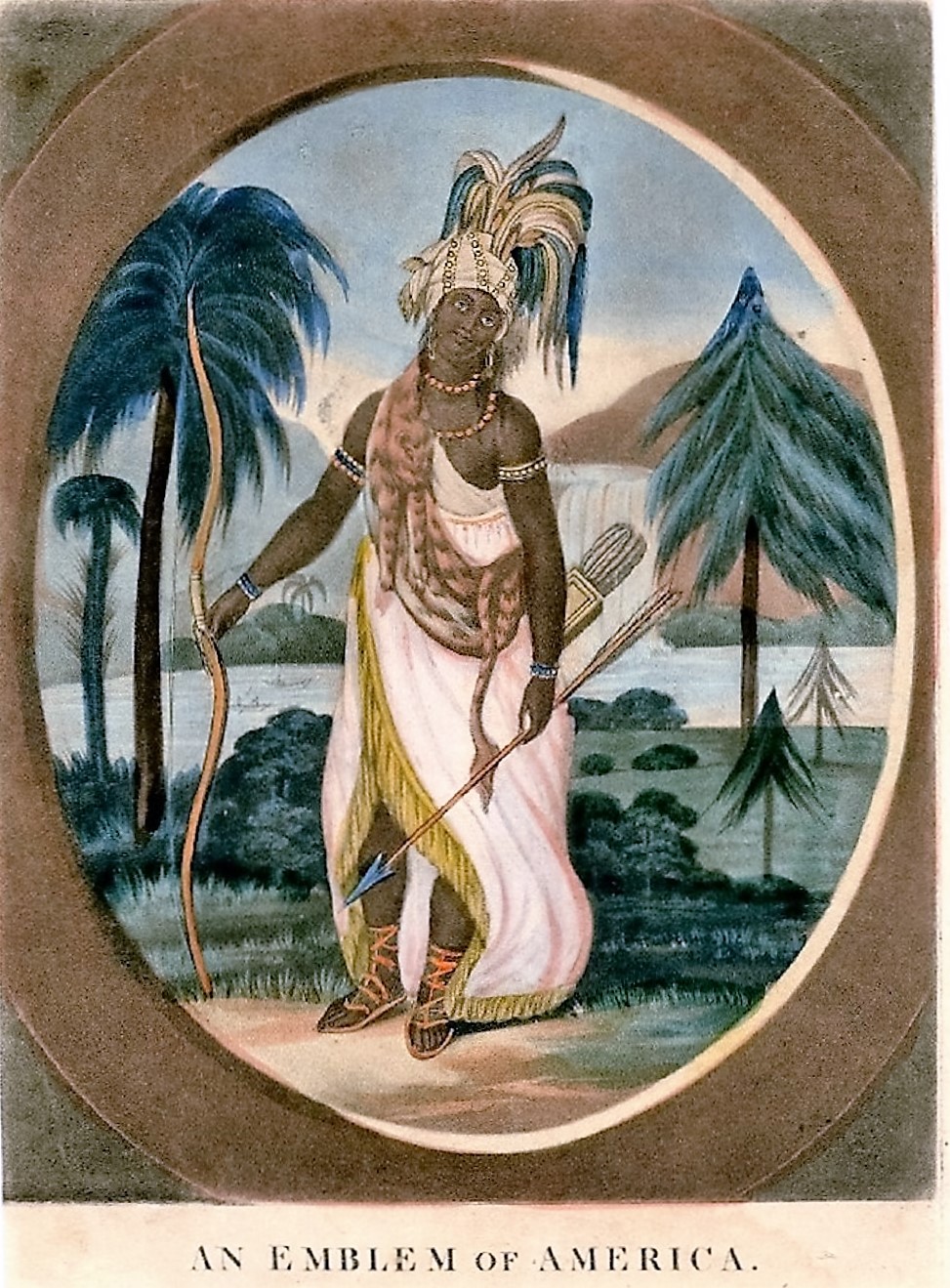
Subscribe to:
Posts (Atom)